ARRL Audio News
| · | To subscribe, unsubscribe, or change your e-mail delivery address: see How to Get The ARRL Letter, below |
| · | Delivery problems (ARRL member direct delivery only!): letter-dlvy@arrl.org |
| · | Editorial questions or comments: Rick Lindquist, N1RL, rlindquist@arrl.org |
| · | ARRL Audio News: http://www.arrl.org/arrlletter/audio/ or call 860-594-0384 |
| · | The ARRLWeb Extra: http://www.arrl.org/members-only/extra |
IN THIS EDITION:
- +Praise for hams' response in Florida
- +Ham radio makes the Times
- +Mir-school QSO postponed
- +Mir packet system back on line
- +Amateur Radio Outlook Committee seeks comments
- +RAC Board lashes out at government decision
- Georgia club holds "Tech Fest"
- 1998 YHOTY nominations open
- Solar update
- In Brief: This weekend on the radio; New Mississippi SM; ICOM DSP board for IC-706MkII and PCR1000; NN0DJ tapped to be AMSAT News Service Editor; N3OFZ is new SkyWarn TC head; FCC jumps the gun on call sign reissue; InstantTrack FAQs available; You can't beat the price; Winter SWL Festival set; antenneX adds modeling column
+ Available on ARRL Audio News
EMERGENCY OFFICIAL PRAISES FLORIDA HAM RESPONSE
Osceola County, Florida, Emergency Management Coordinator Steve Proctor says hams bridged the gap when tornadoes and heavy thunderstorms wreaked havoc on central Florida February 23. "We had a great response," Proctor said this week. He estimated that as many as 30 hams--some of them from Brevard, Indian River and Polk counties--were directly involved in providing disaster communication and in damage assessment activities in his area. "We had ARES, RACES, and REACT in here working," Proctor said. "Emergency Management was certainly grateful for the assistance." Proctor said he hopes to have his own ham ticket soon.
In the hours right after the surprise disaster, the Red Cross did not have any communication from its four emergency shelters, Proctor said. Telephone service was disrupted when a main telephone trunking station was badly damaged by the storms. Proctor said Osceola County had to move to its secondary EOC in Kissimmee as a result.
As the bad weather moved in, Central Florida hams activated a SkyWarn net on advice of the National Weather Service in anticipation of severe storms. Storm-spotting hams stayed on duty during the evening of February 22--when the first tornado was reported in Volusia County--and into the early morning hours of February 23. At one point, SkyWarn newcomer Paul Catineau, KF4UTN, announced to the net, "The sky is boiling!"
Emergency Coordinators Bernie Farthing, NP2CB, in Orange County, Dick Fess, K4FUY, in Seminole County, and Bill Crandall, KM4AE, in Volusia County activated their EOC positions and ARES and RACES teams early on February 23. The Red Cross was among the first agencies requesting amateur support. Dozens of other hams participated at EOCs and shelters or in damage assessment and communication support.
Army and Air Force MARS stations also assisted during the storm assessment and recovery. Army MARS Public Relations Coordinator Lorraine Matthews, N4CZF/AAA9PR, said the experience that Florida Army MARS members gained from Hurricane Andrew and subsequent storms "served well to get Florida Army MARS activated for this emergency as well." Matthews said MARS stations supplied essential information reports to Army MARS management and the Directorate of Military Support. These reports are shared "with the appropriate federal agencies who might be requested to assist," she said. Army MARS utilized existing nets, and stations remained on the air throughout the day in the storm's aftermath.--thanks to Steve Proctor, Lorraine Matthews, N4CZF, Mike Welch, KF4HFC, Norm Lauterette, WA4HYJ, and Dave Flagg, N4BGH
ALL THE NEWS THAT'S FIT TO PRINT--AND HAM RADIO TOO
Ham radio got some highly visible ink March 5 in one of the nation's most prestigious newspapers--the New York Times. The article, "Ham Radio, Version 2.0, for the Silicon Era," by John Verity, appears in The Times' new "Circuits" section, on page G9. Among those prominently mentioned in the article was AMSAT-NA Executive Vice President Keith Baker, KB1SF, who's also pictured in his shack. Baker says photographer Chris Kasson showed up at his Xenia, Ohio, home a few weeks ago and spent several hours snapping pictures of his gear, his shack, his antennas, and him. Also quoted was ARRL Advertising Manager Brad Thomas, KC1EX. ARRL Media Relations Manager Jennifer Gagne, N1TDY, worked with Verity in developing the article.
Verity's premise: "A new, digitally hip generation is sweeping into ham radio and virtually reinventing it from the inside out." He talks about how much of the hobby has become computer-oriented, reliant as much on "microchips and software" and links to the Internet as on the more traditional hardware associated with hams. The article focuses on some of the more futuristic types of amateur activities such as satellites, although the pending Phase 3D is not mentioned. The article included both the ARRL and AMSAT Web sites. Also mentioned were moonbounce, ATV, and SSTV. Even the Heathkit Virtual Museum (http://www.cyberventure.com/heath.html) got a plug.
Baker says the article was great publicity for Amateur Radio and for AMSAT. "Mr Verity and I spent a few hours on the telephone talking about the continuing magic of Amateur Radio and what AMSAT has done to spark new ways of telecommunication over the years," he said. Baker said Verity "was quite impressed with the ease with which we regularly communicate through our fleet of AMSAT satellites," and especially that hams can hit some satellites using an H-T. "If it sparks enough interest in just one youngster to become a ham, then it was well worth the effort!"
Hams may raise their eyebrows when they come to the part where Verity cites 4000 W as "the legal maximum" for amateurs. Even though "it says so in the newspaper," the legal limit remains 1500 W PEP.
Seeing the article sparked renewed interest for at least one inactive ham. Leonard Spear, WA1LBC, of West Palm Beach, Florida, and Branford, Connecticut, called HQ to say he's now excited about getting back into ham radio, and especially finding out more about satellites and packet radio.
Those who can't get a hard copy of The New York Times can view the article at http://www.nytimes.com/library/tech/98/03/circuits/articles/05ham-radio.html.
MIR-SCHOOL QSO POSTPONED
Students at Carey Junior High School in Cheyenne, Wyoming, hope to get another chance to make contact later this month with US astronaut Andy Thomas, KD5CHF, aboard Mir. Originally scheduled for March 3, the contact with the Wyoming school had to be postponed when the Mir crew was called upon to conduct a spacewalk that day. Technical problems aborted even that excursion, however, after the crew was unable to open a hatch.School-Mir contacts resumed in late February after a year-long dry spell. Thomas already has enjoyed successful and spirited contacts with youngsters at schools in California, Colorado, and South Carolina. The tentative schedule calls for additional school contacts later this month. Dates and times will be worked in around Thomas' schedule aboard Mir.
Thomas has also been making himself available for routine contacts with Earthbound hams on 70 cm. Mike Seguin, N1JEZ, reports he had the pleasure of briefly speaking with Thomas on February 15, 1998. Thomas was using the RR0DL 70 cm QSO frequencies at the time. As already reported, Al Emer, N2YAC, also spoke with Thomas on 70 cm. Both operators said Thomas was in good spirits and looking forward to more on-the-air time in the future. Tony Hutchison, VK5ZAI, reports that he had a six-minute chat with Thomas on February 22 on 145.985 MHz. Thomas used his Australian-issued VK5MIR call sign during that contact.
The initial Mir QSO mode frequencies are 435.725 MHz up (with a CTCSS tone of 151.4 Hz) and 437.925 MHz down. Earth stations must correct for Doppler shift (just as when using the SAFEX repeater). Many stations program shifts into a set of 10 or so memory channels. --thanks to the SAREX Working Group and to AMSAT News Service
MIR PACKET SYSTEM BACK UP; APRS EXPERIMENT SET
The Mir International Amateur Radio Experiment (MIREX) team reports the 2-meter packet (PMS) system aboard the Russian spacecraft is back in operation. A new TNC (a Kantronics KPC-9612 Plus, Rev 8.1) has been installed. MIREX notes the command set for this TNC differs from the previous TNC. The new system is set to time out after two minutes (120 seconds) of idle connect time. It still has a single-user mailbox. Only one station can connect to the R0MIR-1 mailbox at a time. The new modem has 100 kB of message memory, however. At present, only 1200 baud packet is available.
MIREX has announced an Automatic Packet/Positioning Reporting System (APRS ) test on the R0MIR digital repeater aboard Mir. The approximately two-hour experiment on March 10 will run from 1455 UTC to 1651 UTC. During that time period only, APRS stations will be allowed to use the R0MIR repeater. The two orbits involved will cover most of the continental US.
MIREX says it hopes that schools and others will be able to log into the APRS Web site at http://www.aprs.net to track APRS beaconing stations all across the US. Steve Dimse, K4HG, who runs the site at the Miami Museum of Science, says the system runs his APRServe program. So those browsing the site to view the experiment will not be overwhelmed by the thousand or more stations typically visible, Dimse has set up the special page for the experiment at http://www.aprs.net/mirex.html to filter out all packets that are not transmitted via R0MIR. The page also will show Mir's position, and Dimse says it will provide an excellent way to view the event. MIREX CEO Dave Larsen, N6CO, says the experiment "has been a long time in the planning, and I hope it will serve as a step for other experiments along the same line." The Mir PMS frequency is 145.985 FM simplex. APRS should not be used on Mir after 1651 UTC on March 10.--MIREX
AMATEUR RADIO OUTLOOK COMMITTEE WANTS TO HEAR FROM YOU!
The Amateur Radio Outlook Committee wants to hear from you! The committee--appointed last fall during the International Amateur Radio Union Administrative Council meeting in Beijing, China--seeks comments from hams on their views concerning the future of Amateur Radio in the age of the Internet. The comment deadline is June 30, 1998.
IARU President Richard Baldwin, W1RU, appointed the Amateur Radio Outlook Committee. Its members are Chairman Thomas Atkins, VE3CDM; Lou van de Nadort, PA0LOU; and Yoshiji Sekido, JJ1OEY. The idea to solicit comments stemmed from a "lively discussion" at the September Council session about the Internet and its impact on the Amateur Radio Service. This prompted the Council to consider addressing concerns about the future growth and development of ham radio. In addition to reviewing the current and future state of the art in the Amateur and Amateur Satellite Services "in the light of the changing technology and the Internet," the Outlook Committee also will focus on technology, techniques, and future developments, and make general recommendations on the future growth and development of Amateur Radio.
IARU member societies already have begun to discuss the issue. Input from all amateurs is welcome. Address comments to Amateur Radio Outlook Committee, c/o IARU, PO Box 310905, Newington, CT 06131-0905; e-mail aroc@iaru.org; http://www.iaru.org/outlook1.html; http://www.iaru.org/outlook2.html. --IARU
RAC BOARD LASHES OUT AT INDUSTRY CANADA DECISION
The Radio Amateurs of Canada Board of Directors has issued a stinging rebuke to Industry Canada for canceling a project that would have delegated some responsibility for Amateur Radio licensing to a nongovernment service company affiliated with RAC. In a letter February 17 to Industry Canada--that country's equivalent of our FCC--RAC President Farrell "Hoppy" Hopwood, VE7RD, called Industry Canada's cancellation of the Amateur Delegation Project "unprofessional and shortsighted." After four years of cooperation, the IC called off the project late last November without warning. Hopwood has asked for a meeting with John Manley, PC Minister of Industry, possibly in a last-ditch effort to revive the project.
In his letter, Hopwood said, "RAC's Regional Directors were appalled at the lack of consultation over this premeditated action" and "shocked" at how IC officials handled the situation. The Amateur Radio Administrative Services/Services Administratifs Radio Amateurs (ARAS-SARA) would have assumed some ham radio administrative responsibilities for Canada's 47,000 hams.
In his letter, Hopwood said IC's action "has severely damaged the faith, confidence and trust we once enjoyed with members of the department." Hopwood said Canada's hams "were shocked, dismayed, and outraged" by the November announcement that came as many thought the project would become a reality. --Radio Amateurs of Canada
GEORGIA CLUB HOLDS "TECH FEST"
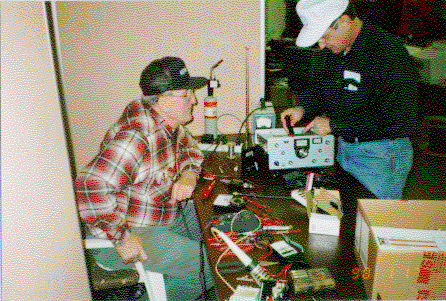 Howie Gould, W4NVF, assists as Gene Gach, KF4NOG, works on his transceiver. |
The Gwinnett Amateur Radio Society in Georgia wanted a way for club members to share their collective wealth of knowledge and experience in Amateur Radio. Their answer? The club's first Tech Fest in mid-January. Tech Fest included an operational HF station staffed by Karl Phillips, K4GZZ, a 2-meter packet setup with John Farr, KD6CLO, at the helm, an SSTV demonstration by Mike Swiderski, K4HBI, and an APRS setup as part of the ARES display presented by Lowry Rouse, KM4Z.
Howie Gould, W4NVF, set up a workbench that included demonstrations on soldering and how to use a multimeter for some hams, plus radio testing and alignment for club members. Jud Whatley, W4NJZ, hauled in lots of vintage Heathkit and Collins gear for his QCWA display.
Other presentations focused on portable generators, how to raid the junk box to build inexpensive antennas for 2 meters, a talk on ARES and SkyWarn, computerized logging, contesting, and coaxial cable characteristics and loss,
Georgia Section Manager Sandy Donahue, W4RU, represented the League. GARS is a Special Service Club.
For lunch, the club's culinary artists prepared a selection chili recipes that ranged from "QRP" (flavorful, but not too spicy) to "full legal limit"--also described as "Hotter 'n a black dawg in the July sun!" Event coordinator Kevin Berry, KF4RMA, says the club already is planning next year's event.--GARS
1998 YOUNG HAM OF THE YEAR NOMINATIONS OPEN
Nominations are open for the Amateur Radio Newsline 1998 Young Ham of the Year (YHOTY). Now in its second decade, the YHOTY award goes each year to a US amateur 18 or younger who has used Amateur Radio to significantly contribute to the benefit of the hobby, to the state of the communications art, to the community or to the nation.
Nominations are due by June 30, 1998, on an official application. To obtain an application, send an SASE to 1998 Young Ham of the Year Award, Newsline, 28197 Robin Ave, Saugus CA 91350. Nomination applications also are available at http://www.arnewsline.org.
The award presentation is scheduled take place at the 1998 Huntsville Hamfest in August. The 1998 Young Ham of the Year will also spend a week at Spacecamp in Huntsville.
Newsline editor Bill Pasternak, WA6ITF, says the purpose of the YHOTY Award is "to highlight the accomplishments of the nation's many young radio hobbyists, and to encourage the entry of more young people into the exciting and rewarding hobby of Amateur Radio." Corporate sponsors include Yaesu USA and CQ magazine. The 1997 YHOTY was Brian Mileshosky, N5ZGT, of Albuquerque, New Mexico. --Bill Pasternak, WA6ITF
SOLAR UPDATE
Solar scholar Tad Cook, K7VVV, Seattle, Washington, reports: Average sunspot numbers were slightly higher, and average solar flux was only a little lower last week. The average solar flux for the previous 90 days declined one point to 95, and flux values were above that level for three days out of the week.
Jim, KC7ZMV wrote with an interesting observation about the comparison of the previous two solar cycles with the current cycle on the web at http://www.dxlc.com/solar/cyclcomp.html, as mentioned in my last report. He noted that the Web site claims that the current cycle began in May 1996, but he had read elsewhere that October 1996 was a more accurate date. If one accepts the latter date, then perhaps the current cycle isn't really lagging the other cycles.
NOAA has the announcement about the revised date at http://sec.noaa.gov/info/SumSept.html. Looking at the charts at the cycle comparison site, it isn't clear whether the graphs are really drawn from the beginning of each cycle or from the minimum. Since they are moving averages, the trend line lags behind the current data about six months. If one looks out beyond the trend line on the current cycle it appears that the data have leveled out, and this is born out in the current monthly average just calculated. The monthly average solar flux values for November through January were 99.5, 98.7 and 93.4, and in February the average flux was 93.4, precisely what it was in January. We can hope for better, but it still looks like solar activity is lagging.
Conditions should be fairly good for the ARRL International DX SSB Contest this weekend, with predicted solar flux for Friday through Sunday at 94, 92 and 90. No geomagnetic disturbances are foreseen. Solar flux should increase after the weekend, rising above 100 around March 13 and dipping back into the high 90s after March 17.
Sunspot numbers for February 26 through March 4 were 69, 78, 60, 93, 105, 56, and 55 with a mean of 73.7. The 10.7-cm flux was 92.7, 90.3, 94, 98.3, 91.5, 96.6, and 101.7, with a mean of 95, and estimated planetary A indices were 3, 4, 12, 12, 14, 4, and 8, with a mean of 8.1.
In Brief:
- This weekend on the radio: The ARRL International DX Contest (SSB) is the event of the weekend. Just ahead: The QCWA, Wisconsin, and Missouri QSO parties all are next weekend.
- New Mississippi SM: Mississippi has a new Section Manager. He's Malcolm Keown, W5XX, of Vicksburg. Keown was appointed to replace Ernest Orman, W5OXA, of Biloxi, who has stepped down. Orman had been SM since 1995.
- ICOM DSP board for IC-706MkII and PCR1000: ICOM now offers an add-on DSP board for the popular IC-706MkII transceiver and the PCR1000 "black box" PC-controlled receiver (sorry, this does not work with the original IC-706). This AF DSP circuit provides automatic notch filter and noise reduction functions. When you plug it in, the unit activates icons on the display or screen. The UT-106 DSP unit should be available from retailers very soon. It carries a manufacturer's suggested price of $166.
- NN0DJ tapped to be AMSAT News Service Editor: In the wake of the sudden and untimely death of BJ Arts, WT0N, AMSAT has announced that Dan James, NN0DJ, will assume the ANS Editor duties. Dan already had been assisting BJ Arts for several months and was listed as an Assistant Editor on some postings. James was first licensed in 1969 as WN7LSF. A Montana native, he now lives in Warroad, Minnesota, and is a facility instructor for a major window manufacturer. NN0DJ has an extensive background in broadcast journalism and is very active on many of the current amateur satellites.--AMSAT News Service
- N3OFZ is new SkyWarn TC head: Robert Hill, N3OFZ, of Pocono Hill, Pennsylvania, has been named chairman of the SkyWarn Technical Committee for the National Weather Service. He succeeds Paul Toth, K2SEC. Hill and other members of the Tech Committee also received a Special Service Award from the National Oceanic and Atmospheric Administration in recognition of their help in reorganizing the SkyWarn Amateur Radio network, the development of APRS and the SkyWarn paging system, and for SkyWarn spotter education through organizing training programs.--The Hudson Loop
- FCC jumps the gun on call sign reissue: Ron Toller, N1RT, has learned that the FCC reissued his former call sign, WO4L, to a Florida man, less than 12 months after he gave it up in 1996. The FCC's vanity rules say call signs will be held out of the pool for two years before being reissued. Toller didn't find out until recently that the call sign had been reissued. He said a spokesman at the FCC's Gettysburg office blamed the premature release on "a computer glitch." The same individual told the ARRL that by the time the FCC discovered its error, it decided not to rescind the grant because of the number of licenses that had been granted by then and the amount of time that had passed before the problem was discovered. Toller's take on the turn of events? "If all the hams must obey the rules so should the FCC." He says he's petitioning to have the FCC vacate WO4L until the two-year period is up in November.
- InstantTrack FAQs available: AMSAT Vice President for Electronic Communications, Paul Williamson, KB5MU reports that he has just completed and published a set of frequently asked questions (FAQs) for the satellite- tracking program InstantTrack. This program is widely used by many satellite operators around the world. You can find the FAQs at http://www.amsat.org/amsat/intro/itfaq.html. This information also is available as a downloadable document from the AMSAT FTP site. The file is about 40 kB.--AMSAT News Service
- You can't beat the price: The latest upgrade of HAMCALC (Ver 31) now is available from George Murphy, VE3ERP, 77 McKenzie St, Orillia, ON L3V 6A6 Canada, for just US$5 (check or money order). HAMCALC contains more than 200 "painless" math and design programs for hams and electronics professionals. Murphy will send it out airmail to anywhere in the world. The program runs under DOS. Murphy says it's being upgraded all the time. Among the many programs on the disk are an antenna field strength calculator, a coil tap calculator, and a decibel calculator.
- Winter SWL Festival set: The 1998 Winter SWL Festival will be held March 13-14, 1998, at Kulpsville, Pennsylvania (near Philadelphia). Forum topics include sessions for beginners, "The Year in Pirate Radio," new equipment, longwave DXing, and antennas. For more information, see http://www.trsc.com/swl_fest.html or contact Thomas Sundstrom, W2XQ, e-mail trs@trsc.com; tel 609-859-2447; fax 609-859-3226.--Thomas Sundstrom, W2XQ
- antenneX adds modeling column: The on-line monthly magazine antenneX has added a regular column focusing on antenna modeling, edited by renowned antenna guru LB Cebik, W4RNL, of Knoxville, Tennessee. In his premier outing, "Converging Toward Excellence," Cebik discusses the value of convergence testing when using antenna modeling programs. Now nearly a year old, antenneX, is edited by Richard Morrow, K5CNF. It's a subscription publication (a six-month sub is $19.97 in the US or $21.52 for Texas residents--including state sales tax), but several areas offer free access. The publication has recorded more than 62,000 reader visits since it began "publishing" in May 1997. Visit antenneX at http://www.antennex.com/. For more information, contact Jack Stone, 512-855-0250; e-mail jack@antennex.com; snail Box 72022, Corpus Christi, TX 78472.