ARRL Audio News
| · | To subscribe, unsubscribe, or change your e-mail delivery address: see How to Get The ARRL Letter, below |
| · | Delivery problems (ARRL member direct delivery only!): letter-dlvy@arrl.org |
| · | Editorial questions or comments: Rick Lindquist, N1RL, rlindquist@arrl.org |
| · | ARRL Audio News: http://www.arrl.org/arrlletter/audio/ or call 860-594-0384 |
| · | The ARRLWeb Extra: http://www.arrl.org/members-only/extra |
IN THIS EDITION:
- +SAREX scrambles to fill Mir dance card
- +Hams help in second Tennessee tornado
- +ARRL team to compete in world foxhunting competition
- +Red Cross honors New York ARES/RACES
- ARRL Foundation 1998 scholarship winners
- Collins papers to University of Iowa Libraries
- Amateur satellite demo a hit
- Ukrainian DXer to visit US
- Solar update
- William V. "Bud" Hargreaves, K4HMV, SK
- In Brief: This weekend on the radio; Vanity update; April QST Cover Plaque winner; FCC's Gary Stanford retires; Virginia ARRL member license plates; Wisconsin sesquicentennial stations to air; Dayton Contest Dinner set; VK to US 28 MHz "pedestrian mobile"; Africa Telecom 98 special event
+ Available on ARRL Audio News
SAREX SCRAMBLING TO FILL THOMAS' DANCE CARD
With only weeks to go before US astronaut Andy Thomas must return to Earth from the Russian Mir space station, efforts are under way to schedule as many Mir-school contacts as possible. Thomas, who's KD5CHF, is scheduled to end his tour aboard the aging Russian space outpost in early June.
On tap for May so far are Mir Amateur Radio contacts with schools in New Hampshire, South Africa, Texas, Tennessee, and, possibly, Connecticut. The South African contact will occur during the Africa Telecom 98 conference, to demonstrate how Amateur Radio on Mir--and eventually aboard the International Space Station--can benefit education. Attempts also are being made to firm up contact schedules with school groups in Australia. The Australian government has issued Thomas, a native of Adelaide, the special call sign VK5MIR.
Thomas has been especially active in recent months catching up on the backlog of school contacts, which were halted after serious technical problems cropped up aboard Mir in 1997. He has also managed a few casual contacts. Nearly all of the activity has been on 70 cm.
The Mir crew has been preoccupied the past few weeks with repair work that included a series of space walks that precluded Amateur Radio activities. Last week, Mir's cosmonauts and ground controllers fired up the station's new thruster engine. The engine keeps Mir's solar panels properly oriented toward the sun. Cosmonauts Talgat Musabayev, RO3FT, and Nikolai Budarin, RV3FB, completed three space walks during April to replace the thruster.
HAMS HELP IN SECOND TENNESSEE TORNADO
While an April 16 tornado in downtown Nashville, Tennessee, got most of the media attention that day, a second potent storm struck some 70 miles to the south in Lawrence County. Hams mustered to help in storm spotting, rescue and recovery, and damage assessment.
Ron Mott, W4RDM, of Lawrenceburg says SKYWARN spotters saw the tornado as it approached and tracked its path across the county. Mott owns and maintains the 2-meter repeaters used for weather spotting.
Bill Phillips, WD4KQV, says the SKYWARN Net was activated on 2 meters the afternoon of April 16 and ham weather spotters were "among the first to report the tornado entering the county from the west." Phillips says the SKYWARN Net operates in cooperation with the local Emergency Management Agency, and net control operations reside at the Lawrence County Emergency Operations Center. SKYWARN reports were relayed to the National Weather Service office in Nashville and to media outlets in Lawrenceburg and in Huntsville, Alabama.
Mott says that, at one point, a tornado picked up a one-ton truck and dropped it some 15 miles away.
Phillips says the SKYWARN activity helped speed up the official response to the emergency. "Because the group is well known in the community, local fire departments and other county agencies monitor the SKYWARN repeater and were able to start emergency service personnel into the stricken areas almost immediately," he reports. SKYWARN members began damage assessment once the tornado had cleared the county. During this phase, hams discovered at least two injured people and summoned help via ham radio.
The next day, hams helped to complete the damage assessment, which eventually led to Lawrence County's being designated a federal disaster area. Based on damage reports, the storm was officially upgraded from an F4 to an F5.
In ceremonies April 21, SKYWARN members were officially recognized for helping to save lives in northern Lawrence County by providing early warning of the approaching storm. County officials commended the group's efforts and presented citations to those who had helped in the storm-spotting activities.
Pictures of the storm are on the Lawrence County SKYWARN page at http://www.usit.com/mottrd/swarn.htm
US TEAM TO TAKE ON WORLD-CLASS FOXHUNTERS
For the first time ever, a team of US hidden transmitter hunters--or "fox hunters"--plans to compete at the ninth ARDF World Championships. The US team will represent the ARRL at the event, to be held September 1-6 in Nyiregyhaza, Hungary (250 km east of Budapest). More than two dozen countries are expected to send their best on-foot foxhunters to this world competition, being organized by the Varosi Radio Club in Nyiregyhaza. The eighth ARDF World Championships were held last September in Sankt Englmar, Germany.
The ARDF World Championships follow established IARU foxhunting rules, using standard orienteering maps, punches, cards, and control flags. During separate events on 2 meters and 80 meters, five low-power "fox" transmitters are concealed in a large woods. The VHF and HF events are held on separate days. Each competitor, working independently, uses direction-finding techniques to find as many foxes as possible within two hours. Competitors and awards are separated into divisions on the basis of age and sex.
The ARRL's ARDF Coordinator Joe Moell, K0OV, says there's still room on Team USA for more foxhunters. Each competitor must be responsible for his or her own transportation, food, lodging and incidentals. For more information on how you can participate, contact Moell at Box 2508, Fullerton, CA 92633; e-mail homingin@aol.com. "Time is of essence, because diplomatic and travel arrangements must be made well in advance," Moell says. Canadian amateurs should contact RAC National ARDF Coordinator Perry Creighton, VE7WWP, 4011 Hollyridge Place, Victoria, BC V8N 5Z8.
For more information on ARDF, visit the K0OV Web site, http://members.aol.com/homingin/.
RED CROSS HONORS NEW YORK ARES/RACES
The American Red Cross chapter of Northeastern New York has formally recognized Amateur Radio's role during the January 1998 ice storm by presenting New York State RACES with its 1998 Good Neighbor Award. The award also acknowledged the hobby's continued support for the disaster relief agency.
At an April 28 ceremony in Albany, New York, former SEC Anthony Pazzola, WB2BEJ, and former DEC April Stack, K2ZCZ, accepted the award on behalf of all New York State ARES/RACES members who supported the ice storm operations. The Good Neighbor Award goes each year to an individual or organization outside of the American Red Cross that makes a significant humanitarian contribution to the local, national, or international community.
Pazzola and Stack, both communications officers for the chapter and members of the Northeastern New York Disaster Services Committee, received individual award certificates.
Pazzola and Stack will convey the award to New York State RACES Officer Ken Goetz, N2SQW, of Greene County at a ceremony this month. In addition to seeing North Country duty from the New York State Emergency Management Office, Goetz also advised amateur coordinators during the ice storm operation. The award will be on display in the New York State Emergency Management Office radio room--known to New York amateurs as "The Bunker." --April Stack, K2ZCZ
ARRL FOUNDATION 1998 SCHOLARSHIP WINNERS NAMED
The ARRL Foundation Scholarship Committee has announced recipients of its 1998 academic scholarship awards. Congratulations to these scholarship winners:
James T. McDonald, Jr, KC7EFP, Phoenix, Arizona: The ARRL Scholarship to Honor Barry Goldwater, K7UGA ($5000)
Greg L. Magone, KB7QPS, Whitefish, Montana: The Mary Lou Brown Scholarship ($2500)
Jeffrey L. Mah, N9JYL, Buffalo Grove, Illinois: The Earl I. Anderson Scholarship ($1250)
Nancy A. Dekat, KB0SDS, Belvue, Kansas: The Paul and Helen L. Grauer Scholarship ($1000)
David S. Curry, KG2EB, Victor, New York: The Perry F. Hadlock Memorial Scholarship ($1000)
James S. Sikorsky, Jr, N3PHB, Wapwallopen, Pennsylvania: The You've Got A Friend In Pennsylvania Scholarship ($1000)
Jack E. Cohoon, KE4YWM, Augusta, Georgia: The L. Phil and Alice J. Wicker Scholarship ($1000)
Patrick D.T. Kelly, N7UKI, Phoenix, Arizona: The Charles N. Fisher Memorial Scholarship ($1000)
Scott A. Zastoupil, KB0KFX, Williston, North Dakota: The K2TEO Martin J. Green Sr. Memorial Scholarship ($1000)
The General Fund Scholarships ($1000 each) to: James P. Born, KB8HIP, Kenton, Ohio; Emily A. Dunker, AA0PG, Vernal, Utah; Jose E. Gonzalez, KE6WDQ, N Miami Beach, Florida; Paul J. Rudnicki,KB7MFJ, Layton, Utah; Jeffrey P. Morris, N3WEL,Hockessin, Delaware; James J. Behnke, K2VER, Highland Lakes, New Jersey; and Gregory R. Doppke, N8TYP, Casco, Michigan
Zachary S. Clobes, W0ZL, Hutchinson, Kansas: The Irving W. Cook, WA0CGS, Scholarship ($1000)
Richard S. Garrett, AA0CR, Florissant, Missouri: The PHD ARA Scholarship ($1000)
David A. Arthur, W2DAA , Charlton, New York: The F. Charles Ruling, N6FR, Memorial Scholarship ($1000)
James W. Gregory, AD4GN, Atlanta, Georgia: The Charles Clarke Cordle Memorial Scholarship ($1000)
Melissa D. Marshall, N5KK, Tulsa, Oklahoma: The Tom and Judith Comstock Scholarship ($1000)
Roy M. Crownover, AB5EB, New Braunfels, Texas: The North Texas Section-Bob Nelson, KB5BNU, Memorial Scholarship ($750)
The New England FEMARA Scholarships ($600 each) to: Rohan M. Amin, N1PCT, Bethel, Connecticut; Swaminathan Kumaresan, KD1QV, Wakefield, Rhode Island; Jason M. LaPenta, N1XFG, Maynard, Massachusetts; Jennifer M. Watt, N1TGF, Stratford, Connecticut; Guinnevere Hand-Boniakowski, KA1ZWK, Wells, Vermont; Scott A. Garman, KD1GR, Nashua, New Hampshire; Dawn D. Hopkins, KE6AHG, Sunnyvale, California; Thomas H. Lochner, N1QOF, New Canaan, Connecticut
Christopher P. Brophy, KB9HID, Grafton, Wisconsin: The Edmond A. Metzger Scholarship ($500)
Joseph G. McCullough, N9XAE, Chillicothe, Illinois: The NEMAL Electronics Scholarship ($500)
David C. Sansone, KB2WEV, Webster, New York: The Dr. James L. Lawson Memorial Scholarship ($500)
Timothy T. Tye, KJ5IO, Krum, Texas: The Fred R. McDaniel Memorial Scholarship ($500)
Brett M. Bonomo, KB9KTK, Morris, Illinois: The Six Meter Club of Chicago Scholarship ($500)
David A. Schick, W9OFA, Noblesville, Indiana: The Chicago FM Club Scholarship ($500)
Adam G. King, N9JRC, Eau Claire, Wisconsin: The Michael J. Flosi Memorial Scholarship ($500)
Michelle B. Musicer, KD4UCF, Alpharetta, Georgia: The Eugene ""Gene" Sallee, W4YFR, Memorial Scholarship ($500)
Daniel A. Quist, KC5KGB, Elephant Butte, New Mexico: The Albuquerque ARC Scholarship ($500)
The Mississippi Scholarship was not awarded this year.
To apply for 1999 scholarships, send a business-size envelope with two units of first-class postage affixed to The ARRL Foundation Inc, 225 Main St, Newington, CT 06111. The deadline for applications and transcripts is February 1, 1999.
COLLINS PAPERS TO UNIVERSITY OF IOWA LIBRARIES
The papers of the late Arthur A. Collins (1909-1987), founder and president of Collins Radio Company, now part of Rockwell International Corporation, have been deposited at the University of Iowa Libraries, Iowa City. An electronics pioneer, Collins founded the Collins Radio Company in Cedar Rapids, Iowa. The company began producing Amateur Radio equipment in 1933. Collins later expanded to other specialized areas of electronics including aviation, navigation, broadcast and general communications.
During World War II, Collins Radio supplied electronic equipment for the military. Later, Collins was the major communications supplier for the US Manned Space Program. When Admiral Richard E. Byrd planned his expedition to Antarctica in 1933, he selected Collins to build the transmitters he used to keep in touch from the South Pole.
The Collins collection fills 33 large boxes with documents covering the years 1932 through the late 1970s. Materials include correspondence, subject files, photographs, notebooks, corporate annual reports, product literature, product drawings and other working papers. The collection is currently being processed, which involves arranging, preserving and describing the materials so that they will be available to researchers. Processing could take up to a year. For more information on the collection and its contents, contact the University of Iowa Libraries, Department of Special Collections, tel 319-335-5921.--University of Iowa; thanks to ARRL PIO Chuck Gysi, N2DUP
AMATEUR SATELLITE DEMONSTRATION A HIT
Ham radio--and especially satellite operation--was the focus during the recent Space Fair '98 at the Riverside Applied Learning center in the Fort Worth, Texas, area. AMSAT-NA Vice President of Operations Keith Pugh, W5IU, called that the amateur radio satellite demonstration during the week of April 20 a huge success.
Riverside, an elementary school for special kids, this year has placed emphasis on learning about outer space. Among other activities, some 200 students and parents from the school attended a Mir visual sighting party and were treated to a "perfect 60-degree elevation Mir pass," Pugh said.
Satellite demonstrations took place on April 24, with W5IU, WB5QLD and KG5OA participating from Riverside. Satellites used for the on-air demonstrations included FO-20, FO-29, AO-27, AO-16, LO-19, UO-22, KO-23, KO-25 and Mir. Contacts were made on the analog (voice) satellites and messages were also received on the digital satellites from the US, Canada, the United Kingdom, and Austria. W5IU and crew also uploaded several digital messages.
In addition to satellite operation, HF contacts included one with QST Managing Editor Steve Ford, WB8IMY, at W1AW. Others notable contacts included one with W0WR, the Kansas Cosmosphere Station in Hutchinson, Kansas (with KI0MN as op), and another with former astronaut Ron Parise, WA4SIR, operating WA3NAN, the Goddard Space Flight Center Radio Club in Greenbelt, Maryland. Pugh said Parise displayed "patience and grace" answering many questions from the students about his experiences as an astronaut. The school also participated in the Mir school test on April 27.
"For those of us who worked at the school, the enthusiasm displayed by these young children was the best reward we could possibly receive," Pugh said.--AMSAT News Service
UKRAINIAN DXER TO VISIT US IN MAY
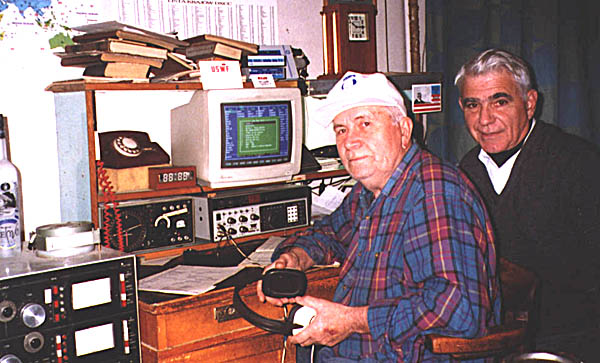 Goncharsky (l) with Barry Cohen, K2JV |
Goncharsky is well-known to the DX community and stands high on the DXCC Honor Roll with more than 371 confirmed DX countries. He is normally active from his home station for all international contests on all modes.
His special, honorary call sign, U5WF, was originally issued by the Soviet Union to World War II veterans. (Goncharsky taught CW to the Red Army Signal Corps during the War, but he also got in trouble with the authorities several times over the years because of his radio activities.) Even after the breakup of the Soviet Union, licensing authorities in Ukraine allowed him to continue to use his one-of-a-kind call sign.
Goncharsky is a founding member of the Virginia-based Foundation for Amateur International Radio Service (FAIRS), along with his son Victor, US5WE, and daughter-in-law Helen, UR5WA. Father and son visited the US and ARRL HQ in 1992 as guest of FAIRS.--Barry G. Cohen, K2JV
SOLAR UPDATE
Solar sage Tad Cook, K7VVV, Seattle, Washington, reports: Thanks to KH6BZF for writing this bulletin while I was in Maui. Those who keep careful track of the numbers at the end of these bulletins or who use them in the WA4TTK Solar Data Display program may have noticed that there was a one day gap in last week's numbers. The complete stats for the past two weeks are at the end of this bulletin.
A trip to another region is always interesting when one can observe propagation. For this author, it was Bahia, Brazil in late 1995 and Maui, Hawaii, at KH6X last week.
The station and location were ideal, with no local noise sources and big antennas high above the Pacific. Being from the Pacific Northwest, the first thing I noticed was that ten meters was often open to the southern part of the United States, but never to northern latitudes, at least with the sunspot activity as it was.
Solar flux has been declining over the past few weeks, and now it is back on the rise. The predicted flux values for this Friday, Saturday and Sunday are 104, 106 and 108. Beyond that, flux values are expected to peak near 130 around May 8 and 9, then decline below 110 around May 15 and below 100 by May 17. Geomagnetic conditions have been active due to solar flares and coronal holes. The worst days recently were April 24-26, and we should see poor conditions again this Saturday, due to a flare on April 29 at 16:37 UTC. Active conditions should return next month around May 21-23 with an active coronal hole.
For the next few weeks, look for best worldwide propagation on 20 meters, with openings following local sunrise and continuing through the day. After dark, 20 should be excellent into the tropical regions well into the night. Because of shorter dark hours, 40 should offer fewer openings. When solar flux is up, look for openings on 10 and 15 meters, particularly when WWV reports K indices of 2 or lower.
Sunspot numbers for April 16 through 22 were 59, 70, 28, 35, 35, 47, and 41, with a mean of 45. The 10.7 cm flux was 106.4, 101.3, 98.5, 96.2, 97.7, 92, and 87.6, with a mean of 97.1. The estimated planetary A indices were 7, 15, 6, 4, 10, 7, and 6, with a mean of 7.9.
Sunspot numbers for April 23 through 29 were 38, 22, 50, 30, 19, 54, and 65, with a mean of 39.7. The 10.7-cm flux was 90.2, 90.6, 91.9, 90.7, 91.4, 98.4, and 100.5, with a mean of 93.4. The estimated planetary A indices were 14, 35, 22, 31, 14, 10, and 6, with a mean of 18.9.
WILLIAM V. "BUD" HARGREAVES, K4HMV, SK
The "Father of the PolyCom," William V. ("Bud") Hargreaves, K4HMV (ex W2SXB), of Pompano Beach, Florida, died January 3, 1998, after a long illness. He was 67. As chief engineer at Polytronics Laboratories in the early 1960s, Hargreaves designed the popular PolyCom 6&2, PolyCom 2, and PolyCom 6 AM transceivers and other products. When Polytronics closed in 1965, Hargreaves began a career at Electronic Communications Inc in White Plains, New York, where he designed CB and commercial transceivers under the Courier brand name. A former US Marine and lifelong amateur, he also was an accomplished organist. His wife, Shirley, K4HMU, a son, and a daughter survive.--Henry G. "Hank" Grilk, WA2CCN
In Brief:
- This weekend on the radio: The Connecticut QSO Party, the Massachusetts QSO Party, the ARI International Contest, the Ten-Ten International Net Spring CW QSO Party, the Danish SSTV Contest, and the MARAC County Hunters CW Contest are on tap for this weekend. Just ahead: The ARRL VHF/UHF Spring Sprint for 902/1296/2304 MHz, the FISTS CW Club Spring Sprint, and the Indiana, Nevada, and Oregon QSO parties are the weekend of May 9-10.
- Vanity update: The FCC in Gettysburg has processed vanity call sign applications through April 6, including all work in process. The FCC issued 190 new call signs on April 28. Another 213 applications ended up in the WIPs stack.--FCC
- April QST Cover Plaque winner: Jim McMasters, KM5PO, won the April QST Cover Plaque Award for his article, "High-Speed CW and Meteor Scatter-An Exciting VHF DX Medium." Congratulations, Jim!
- FCC's Gary Stanford retires: Gary L. Stanford, W4FDP, the associate bureau chief in the FCC's Wireless Telecommunications Bureau, has retired, effective May 1. Stanford joined the Commission in 1961. An electrical engineer, he joined the Private Radio Bureau in 1983 and became acting chief of the Land Mobile and Microwave Division in 1986. Later that year, he was named to head the PRB's licensing division at Gettysburg and was elected into the Senior Executive Service in 1992. He retires as associate bureau chief for operations within the Wireless Telecommunications Bureau in Gettysburg. Best wishes, Gary!
- Virginia ARRL member license plates: Thanks in part to the efforts of ARRL Roanoke Division Director John Kanode, N4MM, and Vice Director Dennis Bodson, W4PWF, ARRL members in Virginia can request to have the ARRL diamond logo on their license plates, starting July 1. Applicants must be licensed amateurs and ARRL members and have transmitting and receiving equipment permanently installed in the vehicle. Including a call sign on the plate is optional. As with similar "logo" plates in Virginia, the ARRL logo plates cost $10 per year, and there is no additional fee to include your call sign. ARRL logo plates will read "ARRL" below the call sign or plate number, instead of "Amateur Radio," however.--Dennis Bodson, W4PWF
- Wisconsin sesquicentennial stations to air: Wisconsin celebrates its sesquicentennial--150 years of statehood--this month. Several special event stations sporting 1x1 call signs will be active beginning May 2 and continuing through early July. Many operations will be clustered around May 29--Statehood Day in the Badger State. Stations expected to be active and their announced days of operation include: W9S (Madison), May 2-10; W9I (Green Bay), May 22-30; W9B (Belmont), May 29-31; W9W (45/90 marker near Wausau), May 29-30; W9A (Adams County), June 20; W9W (Oshkosh), July 1-5. All stations plan HF and at least some VHF operation on several modes. Certificates will be available for a 9x12 SASE and/or $1. A $1 donation is requested for the W9S certificate or QSL.
- Dayton Contest Dinner set: The sixth annual Dayton Hamvention Contest Dinner, sponsored by CQ Contest magazine, will be held on Saturday, May 16, 1998 at 6:30 PM (cash bar opens at 5:30 PM) in the Van Cleve Ballroom of the Crowne Plaza Hotel, Fifth and Jefferson Streets, Dayton, Ohio (downtown, next to the Convention Center). Tickets are $28, and the deadline to order is May 6. Seating is limited. For tickets, contact Radio Bookstore, Box 209, Rindge, NH 03461; tel 800-457-7373; 603-899-6957; fax 603-899-6826; e-mail nx1g@top.monad.net. Telephone weekdays between 10 AM and 6 PM ET only. Credit card orders are welcome. Tickets will be sent via First Class US Mail no later than May 7. Please allow time for your tickets to arrive. Radio Bookstore is not liable for tickets lost in the mail. G3SXW will give a short dinner program, and the 1998 Contest Hall of Fame inductions will be announced. The North Coast Contesters are handling all dinner arrangements.--Tim Duffy, K3LR
- 28 MHz "pedestrian mobile" VK to US: Here's proof that HF propagation is improving in the new sunspot cycle: Contacts between an Amateur Radio pedestrian mobile station in the Australian capital of Canberra and fixed stations in the US took place March 28 on 10 meters. Using a converted CB transceiver and a nearly 6-foot mobile whip, Peter Parker, VK1PK, made two contacts with the US around midday Australian time. Parker's US QSOs followed a successful contact with ZL2RR earlier that morning. Parker used approximately 8 feet of wire for a ground radial and powered the transceiver from a 12 V battery. He was running around 12 W PEP.--WIA QNews
- Africa Telecom 98 special event: Special event call sign ZS98IARU will be on the air May 4-9 from the IARU Region 1 exhibit at Africa Telecom 98 in Johannesburg, South Africa. Amateur Radio is well represented at this important ITU event. The station will be on the air from 0800 to 1600 UTC each day, and additional hours may be arranged. A special QSL card will be issued. The QSL address is PO Box 1842, Hillcrest 3650, South Africa.--Hans van Groenendaal, ZS5AKV