ARRL Audio News
| · | To subscribe, unsubscribe, or change your e-mail delivery address: see How to Get The ARRL Letter, below |
| · | Delivery problems (ARRL member direct delivery only!): letter-dlvy@arrl.org |
| · | Editorial questions or comments: Rick Lindquist, N1RL, rlindquist@arrl.org |
| · | ARRL Audio News: http://www.arrl.org/arrlletter/audio/ or call 860-594-0384 |
| · | The ARRLWeb Extra: http://www.arrl.org/members-only/extra |
IN THIS EDITION:
- +Field Day 1998!
- A lighter look at Field Day
- +Spectrum Protection bill has 39 cosponsors
- +Missing logs incident prompts apology, changes
- +RAC says just say no to IC
- Morse re-enactors
- Solar update
- +Fred M. Link, ex-W2ALU, SK
- In Brief: This weekend on the radio; Vanity update; Illinois hams respond in tornado's wake; More Amateur Radio proclamations; Reply comment deadline extended; New North Texas SM; New General exam test pool; AEA/Tempo not affected by Timewave filing; Ham radio for the birds? Operation Postcard/QSL; Amateur Satellites--Today and Tomorrow; Harlans take over OSCAR pub; Amateur Radio shines at Tall Ships Riverfest
+ Available on ARRL Audio News
NOTE: Because the Independence Day holiday, ARRL Headquarters will be closed Friday, July 3. The ARRL Letter and ARRL Audio News will be on vacation Friday, July 3 and will return Friday, July 10. The solar/propagation bulletin will be transmitted July 3 by W1AW and also will be available on the ARRLWeb page.--Rick Lindquist, N1RL
FIELD DAY 1998: DON'T OVERLOOK THE NEW RULES
Clubs and individual hams across the US and Canada are gearing up for the 65th Field Day this weekend, June 27-28. Aimed at demonstrating the ability to operate under simulated emergency conditions and arguably the most popular operating event of all, Field Day has some new rules this year.
A major change this year is the elimination of bonus-point credit for packet and VHF/UHF contacts. Field Day stations no longer will be allowed to count contacts via digipeaters, packet nodes, or similar arrangements. Class 2A and higher Field Day stations still may operate a "free" transmitter exclusively for VHF or UHF operation (ie, above 50 MHz) without changing their basic entry classification, but not for bonus points.
These changes have upset some members of the digital community who say that eliminating contacts via digipeaters or packet nodes will discourage packet and APRS altogether. As in the past, crossband and repeater contacts other than via satellite do not count for Field Day credit.
Field Day stations now can earn point credit for digital (ie, non-CW) contacts on each band. The phone, CW, and non-CW digital segments are considered separate "bands" in the Field Day rules. CW and non-CW digital contacts count 2 points apiece. ARRL Contest Manager Billy Lunt, KR1R, says his department gets approximately 2000 official Field Day entries every year.
The first "International Field Day" was held back in 1933. It was the brainchild of then-Communications Manager Ed Handy, W1BDI. The complete, official 1998 Field Day rules are in the May edition of QST on page 108. Field Day takes place each year on the fourth full weekend in June.
A LIGHTER LOOK AT FIELD DAY--SOME TIPS
- You can compress the diameter of your rolled up sleeping bag by running over it with your car. This technique may also be used to make a folded dipole.
- A potato baked in the coals for one hour makes an excellent side dish. A potato baked in the coals for three hours makes an excellent counter-weight for hurling a leader line over a tree limb.
- You can start a fire without matches by eating Mexican food, then breathing on a pile of dry sticks while keying your H-T.
- In emergency situations, you can survive in the wilderness by shooting small game with a slingshot made from the elastic waistband of your underwear. This trick also works for stringing wire antennas.
- The guitar at the next campsite makes excellent kindling. The strings may be used for a VHF/UHF antenna.
- A large carp can be used for a pillow or as a ground for maritime mobile stations.
- Check the washing instructions before purchasing any apparel to be worn on Field Day. Buy only those that read "Beat on a rock in stream" or "Can be dried by HF RF."
- Effective January 1, 1998, you will actually have to enlist in the Swiss Army to get a Swiss Army knife. Contacts with HB stations do not count for bonus points, however.
- Bear bells provide an element of safety for Field Day operators in grizzly country. The tricky part is getting them on the bears.
--Modified for radio amateurs by Pete Kemp, KZ1Z, from the September 1996 issue of Backpacker magazine
AMATEUR RADIO SPECTRUM PROTECTION BILL HAS 39 COSPONSORS
ARRL Legislative and Public Affairs Manager Steve Mansfield, N1MZA, reports that HR 3572, the Amateur Radio Spectrum Protection Act, now has 39 cosponsors (including the original sponsor) and several more members of Congress have indicated their intention of signing on. "Letters from ARRL members are beginning to take effect," Mansfield says.
The bill, introduced March 27 at the request of the ARRL, would protect existing Amateur Radio spectrum against reallocations to or sharing with other services unless the FCC provides "equivalent replacement spectrum" elsewhere. The bill was introduced by Rep Michael Bilirakis of Florida, a Republican, with the cosponsorship of Rep Ron Klink of Pennsylvania, a Democrat.
Cosponsors also now include Peter DeFazio and Earl Blumenauer of Oregon; George Nethercutt of Washington; Frank Pallone of New Jersey; Tom Campbell and John Doolittle of California; Patsy Mink of Hawaii; David Hobson, Tony Hall, Steven LaTourette, Michael Oxley, and Dennis Kucinich of Ohio; Bob Clement of Tennessee; Dave Weldon of Florida; David Price of North Carolina; Robert Wise of West Virginia; Michael Crapo of Idaho; and Jay Dickey of Arkansas.
Others are Representatives Dan Burton of Indiana; Louise Slaughter, Sue Kelly, Michael McNulty and Peter King of New York; Charlie Norwood, Nathan Deal, and John Lewis of Georgia; Bud Cramer of Alabama; Christopher Shays of Connecticut; Collin Peterson of Minnesota; James Talent, Jo Ann Emerson and Ike Skelton of Missouri; Dale Kildee and James Barcia of Michigan; J.C. Watts Jr of Oklahoma; Scott Klug of Wisconsin; and Jon Christensen of Nebraska.
The bill points out Amateur Radio's basic purpose as a "voluntary, noncommercial radio service" that has "consistently and reliably" provided emergency communication during and after disasters. The measure notes that the FCC has "taken actions which have resulted in the loss of at least 107 MHz of spectrum to radio amateurs."
HR 3572 has been referred to the House Commerce Committee. An effort is under way to enlist additional cosponsors for the measure. Amateurs are encouraged to contact their Representatives and urge them to support the bill or to sign on as cosponsors. The full text of the bill is available at http://thomas.loc.gov/cgi-bin/query/z?c105:H.R.3572:
Mansfield is continuing to seek additional cosponsors for HR 3572 and urges individual hams and clubs to contact their representatives in Congress and encourage them to sign on.
MISSING LOGS INCIDENT PROMPTS APOLOGY, IMPROVEMENTS
ARRL Membership Services Department Manager Bill Kennamer, K5FUV, has apologized to the amateur contesting community after a number of ARRL 10-meter Contest logs sent via e-mail--most from high scorers--were not listed when the contest results showed up in July's QST. Blaming the problems on a balky e-mail autoresponder system, Kennamer called the log omissions "an inexcusable error." "It is my intention that this does not occur again," he said in a posting this week to the CQ Contest Reflector.
Kennamer said the e-mail autoresponder worked--indicating to those who had e-mailed that their logs had been received. The problem was that the log gathering procedure did not. "The situation was rectified months ago, but no one notified the world. Thus we had many logs missing, most of them top logs," Kennamer explained.
Kennamer said a new redundant system is in place that uses both an in-house computer to record logs as well as another system outside of ARRL HQ. "You should receive a response that your log has been received, and the log should be saved on two computers," he said.
Kennamer said the League also has instituted a program--effective with the ARRL DX CW Contest--of posting logs received on the ARRLWeb site (http://www.arrl.org/contests/) as soon as the log database is completed. Kennamer said he hopes to eventually be able to provide a daily Web update of logs received. "Meanwhile, we will be posting changes to the received logs list on the CQ Contest Reflector as they occur," he said.
Prominent contester Trey Garlough, N5KO, spent a week at ARRL HQ in May reviewing the Contest Branch and recommended some changes in procedures.
As for the ARRL 10-meter Contest results, these are being updated on the ARRLWeb page. Kennamer said those whose logs still are missing should send another copy of the log file and summary sheet to him at k5fuv@arrl.org. A corrected summary of the contest results is slated to appear in the October issue of QST.
"Our aim is to get back to having the premier contest program in Amateur Radio," Kennamer concluded. "We know that's what you want and deserve, and we're going to make the extra effort to get it for you."
RAC ADVISES MEMBERS TO REJECT LICENSING CHANGES
Radio Amateurs of Canada is advising its members to just say no to Industry Canada's plan to drop Amateur Radio license fees and combine operator and station licenses. RAC says the plan lacks provisions to adequately track call signs, station locations, and operator qualification levels. RAC also says IC--Canada's equivalent of the FCC--has been unable to answer specific questions about the plan.
"Industry Canada's proposal is viewed as another step by the Department to lessen its involvement in regulation of the Amateur Service," an RAC bulletin declared on June 5. "In recent years, Industry Canada has reduced surveillance and enforcement activities to a virtually ineffective level."
Expressing fears of "chaos" ahead, RAC concludes that eliminating the license fee and merging the license documentation "would lead to a further decline in the status of the Amateur Radio Service."
Late last year, the IC scuttled negotiations to delegate partial authority over Amateur Radio licensing in Canada to an arm's length organization associated with RAC. There are approximately 45,000 hams in Canada.
MORSE TO HAVE CIVIL WAR RE-ENACTMENT ROLE
Morse code will play a role in the 135th recreation of the Battle of Gettysburg over the July 4 weekend. Walter Mathers, a member both of the Morse telegraph club's Washington, DC, chapter and the Signal Corps Association 1860-1865, has been appointed Chief Signal Officer for the event, July 3-5, 1998. The Signal Corps Association has formed a re-enactors' division.
Mather says the wire portion of the communication system will include Morse instruments manned by individuals using both the American and Continental codes. "We expect this event to produce over 100 full scale pieces of field artillery--many horse drawn--plus the largest total number of participants ever, which will include the most telegraphers ever assembled at such an event," he said. Mather said 20,000 participants are expected to turn out for the re-enactment, most in period attire.
Mathers, who is not a ham, said that a Morse Telegraph Club member has developed a hidden earphone and converter box to translate the clack of the Morse sounder or relay into a tone for use by wireless operators. "In fact, we'll have more Continental ops than American ops working the lines," he said.
A picture of Mathers (and others) re-enacting the reception of Samuel F. B. Morse's famous message, "What hath God wrought?" appears on page 12 of the August 1991 issue of QST.
SOLAR UPDATE
Solar seer Tad Cook, K7VVV, Seattle, Washington, reports: Solar activity was lower again last week, and geomagnetic indices were unsettled. The average solar flux for the previous 90 days dropped one point from 108 to 107, and the solar flux for every day last week was lower than those figures. This is not a good indicator for an upward trend.
Over the next week the solar flux is expected to rise, reaching 115 from this weekend until the July 4 weekend. The flux should go below 110 again around July 10.
June 26 through 28, Field Day weekend, the solar flux is forecast to be rising, at 110, 112 and 115. Over those same days look for unsettled conditions on June 26 with a planetary A index around 15, and then an A index of 8 over the next two days. It looks like fairly good conditions for this Field Day weekend, with the solar flux about 40 points higher than the 1997 Field Day.
Many readers of this bulletin use the WA4TTK Solar Data Plot Utility by Scott Craig. It grabs data from this bulletin, stores it in a database, then plots the data for you. Users had problems grabbing the data from the past two bulletins due to some inadvertent changes in wording. Scott has released version 3.03 which fixes this problem, and you can download it from his homepage at http://edge.net/~scraig/index.html.
Here are some path projections for the Field Day weekend.
From the East Coast to the West Coast: Check 80 meters from 0230 to 1030 UTC, peaking around 0430 to 0900 UTC. Forty meters should be good from 0030 to 1230 UTC, and peak from 0400 to 0930 UTC. Twenty meters should be open around the clock, with conditions slowly getting better in the evening until 0500 UTC. Fifteen meters may open around 0300 to 0500 UTC.
From the East Coast to the Central US: Check 80 meters from 2300 to 1230 UTC, with excellent signals around 0930 UTC. Forty meters looks good around the clock, peaking from 0100 to 1000 UTC.
From the West Coast to the Central US: Eighty meters looks good from 0215 to 1230 UTC, peaking from 0530 to 1000 UTC. Forty meters is open all the time, but best conditions are from 0400 to 1030 UTC. Twenty meters is best around 2300 to 0800 UTC and 1100 to 1530 UTC. There may be some 15 meter openings from 0330 to 0530 UTC.
From the Pacific Northwest to the Southeastern US: Eighty meters looks good from 0030 to 1100 UTC, and 40 meters from 0030 to 1300 UTC. Twenty meters looks promising from 1500 to 0600 UTC and around 1230 to 1300 UTC.
Don't forget to check 10 meters for sporadic E skip.
Sunspot numbers for June 18 through 24 were 68, 67, 80, 87, 64, 59, and 64 with a mean of 69.9. The 10.7-cm flux was 100.1, 101.2, 101.1, 102, 100.5, 95.7, and 105.3, with a mean of 100.8. The estimated planetary A indices were 7, 14, 14, 15, 10, 10, and 14, with a mean of 12.
TWO-WAY RADIO PIONEER FRED LINK, ex-W2ALU, SK
Fred M. Link, ex-W2ALU, of Pittstown, New Jersey, died June 18. He was 93. Link was best known for his role as a maker of two-way radio gear used extensively by police departments and public service agencies and by the armed forces during World War II. Beyond that, he was a man of wide-ranging interests, from running a horse farm to being involved in local government. He founded the Fred M. Link Company (later Link Radio Corporation) in 1931. The first FM police system, built by Link Radio, was installed at the Connecticut Department of Public Safety headquarters. Link served as president of the Radio Club of America from 1968 until 1992. Among other honors, the club awarded him its Sarnoff Citation in 1976 and its President's Award in 1996. Link was a fellow of the IEEE and a founding member of its Vehicular Technology Society. He had served as a member of its board of governors since 1975. The IEEE honored Link with its Centennial Medal in 1984. Early in his career, Link worked for the De Forest Radio Company as assistant chief engineer for the manufacture of transmitting tubes.
Link has said that his early experiences with ham radio helped him to become the leading manufacturer of police radio gear in the 1930s and 40s. He learned Morse code for a Boy Scout merit badge and worked as a relief railroad Morse operator while only 14. He was first licensed as 3BVA and later became 2ALU and finally W2ALU. As 2ALU, he and his friend Johnny Knight, 4DX, were in contact with the Byrd expedition to the South Pole and helped to relay news of the expedition. The pair also shared other ham radio adventures, including a notorious episode where they managed to get themselves evicted from a New York YMCA while operating a station from there for the 1927 ARRL DX Contest because they were interfering with local radio reception.
Link's wife, Mildred, and a daughter, are among his survivors. Contributions to the Fred M. Link Scholarship Fund are welcome to The Radio Club of America, 3 Caro Ct, Red Bank, NJ 07701. --many thanks to Don Bishop, W0WO
In Brief:
- This weekend on the radio: Field Day! Just ahead: The Canada Day Contest is July 1. The CN-DX Contest is July 4-5. The IARU HF World Championship is July 11-12. Also the weekend of July 11-12: The QRP ARCI Summer Homebrew Sprint and the CQ WW VHF Contest.
- Vanity update: The FCC in Gettysburg reports it has processed vanity call sign applications received through June 2. In its last processing run, June 23, it issued 35 license grants. Another 71 applications landed in the work in process (WIPs) stack.--FCC
- Illinois hams respond in tornado's wake: In the wake of a June 14 tornado, ARES members in the Quincy, Illinois, area joined forces with the American Red Cross to assess the damage. The storm activity damaged homes in at least two subdivisions. In all, five damage assessment teams, each accompanied by a radio-equipped amateur, fanned out to assess damage and injuries, which, fortunately, turned out to be relatively minor. In all, two businesses, a public building, and about two dozen homes were damaged. "Though the disruption to citizens' lives from the storm was painful, the ARES/ARC exercise was a success," concluded Adams County Assistant EC Jim Funk, N9JF. "Confusion was minimal. Volunteers responded quickly and cheerfully. Equipment worked." Funk said the hams learned a few things that should come in handy the next time there's an emergency. --thanks to Bob Crockett, N9KUT
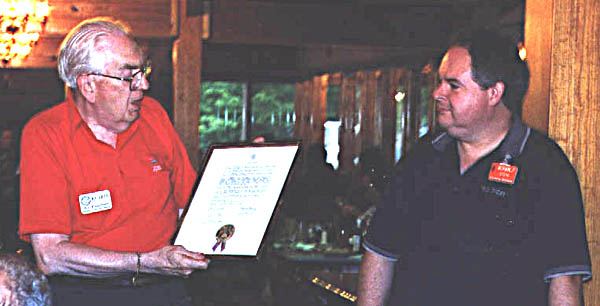
Al Fischer, KC4RIB, presents the Georgia General Assembly's Amateur Radio Weekend proclamation to North Fulton Amateur Radio League President Steve Mays, KS4KJ
- More Amateur Radio proclamations: Michigan and Georgia have joined several other states in issuing proclamations honoring Amateur Radio. In Michigan, Gov John Engler declared June 22-29 as Amateur Radio Awareness Week. The resolution cites Field Day and mentions the ARRL and the SAREX programs. In Georgia, the General Assembly designated June 27-28 as "Amateur Radio Weekend." The resolution specifically mentions Field Day and its role as an emergency exercise. --thanks to George Race, WB8BGY, and Al Fischer, KC4RIB
- Reply comment deadline extended: The date to file reply comments in the LMCC petition to reallocate VHF and UHF spectrum, including parts of 70 cm, to the Private Mobile Radio Service (RM-9267) has been extended to July 16.--FCC Digest
- New North Texas SM: Donald Thomas, KA1CWM, of Coppell, Texas, has been appointed the new Section Manager of North Texas. Thomas replaces Robert Adler, N5NY, who has resigned. The appointment is effective July 1.
- New General exam test pool: A new General class examination question pool becomes effective July 1. The new General exam will include five additional questions on the topic of RF safety. Applicants take note: as of January 1, 1998, only FCC Forms 610 dated September 1997 or later are acceptable to the FCC or to VE teams.--Bart Jahnke, W9JJ, ARRL/VEC
- AEA/Tempo not affected by Timewave filing: Mike Lamb, N7ML, of AEA/Tempo says the company is financially sound and has no connection whatsoever to the recent Chapter 11 bankruptcy filing by Timewave. Lamb said some hams have confused AEA/Tempo and Timewave, both of which purchased different portions of the former AEA product line last year.
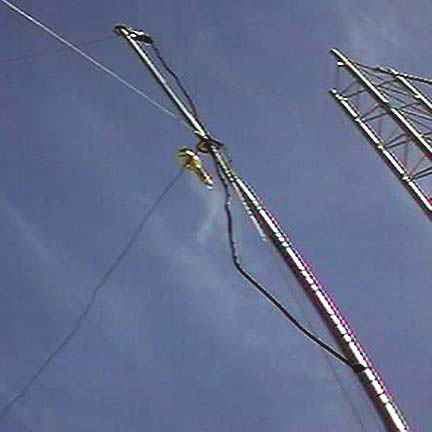
A pet cockatiel that flew the coop sits on a tower support wire prior to rescue by the ham radio tower crew.
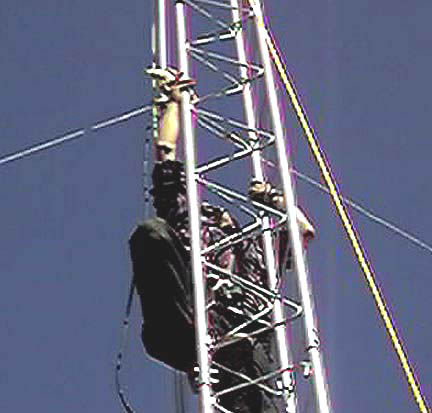
A bird in the hand is worth a climb up the tower. Dave Trujillo snags the cockatiel. Photos by Mike Reed, N7ZEF
- Ham radio for the birds? On May 3, while taking a break putting up a 60-foot tower for Bob Poirier, K0DJ, in Sinclair, Wyoming, the group of hams and a helper looked up and noticed a small bird on a tower support wire. Upon closer examination, they realized it was a cockatiel--someone's pet. The helper, Dave Trujillo, climbed back up the tower, and coaxed the bird to come to him. He then carried the bird to safety. On the ground Ken and Mert Fults, KC7RZI and KC7RZJ, caged the bird and returned it to its owner, who had been trying to get the bird back since the previous evening. The bird was one-half of a breeding pair, and owner Mary Eaton was very surprised and pleased to get it back. --thanks to Mike Reed, N7ZEF
- Operation Postcard/QSL: Pupils at Philippi (West Virginia) Elementary School seek QSL cards from around the US and the world as part of an ongoing school project. School volunteer Debbie Buffum has invited hams to send QSL cards with a brief printed message in care of the teacher, Kathy Chitester, Philippi Elementary School, Rte 3, Box 38, Philippi, WV 26416. Buffum says the project began with a big map of the US and with a piece of yarn from each card to its state of origin. "The teacher would like to go international," said Buffum, whose husband and son both are hams (KD6IPY and KD6MMH respectively). Buffum hopes to see the project include a ham radio demonstration. Philippi is located in North-Central West Virginia, not far from Clarksburg, in Barbour County. --thanks to Ray Day, N6HE
- Amateur Satellites--Today and Tomorrow: Tired of the same old on-the-air stuff? Learn about something new--the exciting world of Amateur Radio satellites! Sign up for a fast-moving, five-hour workshop at the ARRL Southwestern Division Convention, Friday, August 14, 1-6 PM, on everything you need to get "on the birds." Hear about 16 Amateur Radio satellites now in orbit, including an FM satellite you can work with an H-T and the low-Earth orbiting SSB/CW "Easy Sats" on 2, 10, and 15 meters. This session covers equipment requirements, operating protocol, how to track satellites with your PC, and how to get ready for Phase 3D, and much more. Space is limited. To register, contact Dan Miller, K3UFG, at ARRL HQ, 225 Main St, Newington CT 06111; tel 860-594-0340, before Aug 4. The fee is $20 for ARRL members and $25 for nonmembers. The fee covers the cost of materials and five hours of instruction. You might wish to purchase the ARRL's Satellite Handbook, in advance. It's item 6583, and it's $22 (plus $5 UPS shipping/ handling), available via the ARRLWeb site, http://www.arrl.org, or by calling, toll-free, 888-277-5289. This workshop is sponsored by AMSAT and the ARRL Educational Activities Department. Those attending the entire session earn 0.5 Continuing Education Units.
- Harlans take over OSCAR pub: Harlan Technologies has taken over OSCAR Satellite Report from Bob Myers. Shari Harlan, KB9SH, will serve as editor of OSR, published since 1981 and originally named AMSAT Satellite Report. OSR will be mailed twice monthly (24 issues per year) via first-class mail. "We print a DX Satellite column, written by Craig Mellinger, N2MNA, updates on all the satellites and their activity, biographies on the people that you talk to via satellite, orbital elements, and more," says Associate Editor Gene Harlan, WB9MMM. Subscription rates are $35 in the US, $38 in Canada, and $46 elsewhere. For more information, contact Harlan Technologies, 5931 Alma Dr, Rockford, IL 61108-2409; tel 800-557-9469 (orders); 815-398-2683; fax 815-398-2688; e-mail OSReport@aol.com; http://www.cris.com/~Gharlan.
- Amateur Radio shines at Tall Ships Riverfest: Amateur Radio played an important role in the Tall Ships Riverfest highlighting the Rockland County, New York, bicentennial celebration May 23-24. Approximately 125,000 people attended the event along the Hudson River. In all 46 amateurs participated in the two-day event, the largest public event in the county's history. "As a result of all the efforts involved in putting this project together, public awareness of the value of Amateur Radio has been heightened in the county, and we now have further solidified open lines of communication with the various emergency services within Rockland County," said Bob Chamberlain, N2KBC, who thanked the participants. "Not only was our part in the operation a total success, we were afforded an excellent county-wide training exercise that has provided us with new and invaluable emergency response skills."--The Hudson Loop