ARRL Audio News
| · | To subscribe, unsubscribe, or change your e-mail delivery address: see How to Get The ARRL Letter, below |
| · | Delivery problems (ARRL member direct delivery only!): letter-dlvy@arrl.org |
| · | Editorial questions or comments: Rick Lindquist, N1RL, rlindquist@arrl.org |
| · | ARRL Audio News: http://www.arrl.org/arrlletter/audio/ or call 860-594-0384 |
| · | The ARRLWeb Extra: http://www.arrl.org/members-only/extra |
IN THIS EDITION:
- +Bill Tynan, W3XO, retires as AMSAT president
- +Phase 3D satellite undergoing pre-launch testing
- +SEDSAT-1 ready for launch!
- +FCC denies KV4FZ petition for reconsideration
- +W98ITU on the air for "Plenipot"
- Burrowing owls on the move
- IARU Region 2 picks new Executive Committee
- The 1999 Handbook is almost here
- Solar update
- Jules Wenglare, W6YO, SK
- William C. Wells, WA8HSU, SK
- In Brief: This weekend on the radio; AMSAT Annual Meeting special event; Hams pass word on quake; France simplifies reciprocal permit; Patty wins again; Me too! Light trucks get equal plates in Rhode Island; SOHO nearly back in business
+ Available on ARRL Audio News
BILL TYNAN, W3XO, TO STEP DOWN AS AMSAT-NA PRESIDENT
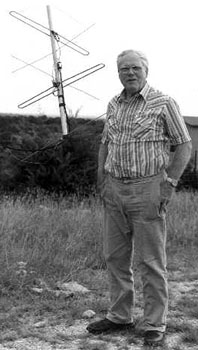 Bill Tynan, W3XO (1992 photo) |
Tynan said he'll recommend to the AMSAT-NA Board of Directors that Executive Vice President Keith Baker, KB1SF, be appointed to replace him. Tynan plans to continue on the AMSAT-NA Board at least until his term expires next year.
Tynan said the outpouring of support for the Phase 3D project was the highlight of his time in office. "The support of both the League and all our members to get where we are is the most gratifying and significant accomplishment," he said.
Licensed since 1945, Tynan edited the "Above 50 MHz" column in QST from 1975 until 1992. In 1988, he retired as senior engineer from the Johns Hopkins Applied Physics Lab. In 1996, he was honored as the Dayton Hamvention's Amateur of the Year.
PHASE 3D SATELLITE TO UNDERGO TESTING
Amateur Radio's Phase 3D spacecraft undergoes pre-launch testing this month in the Washington, DC, area to analyze the satellite's ability to withstand the harsh environment of space. Thermal-vacuum testing is set to begin October 20 at Orbital Sciences Corporation in Germantown, Maryland.
The spacecraft was transported in a well-padded truck from the Phase 3D Integration Lab in Orlando to the DC area. AMSAT-NA Executive Vice President Keith Baker, KB1SF, says the satellite will be placed in a large chamber for the thermal-vacuum test, and most of the air will be removed. "Then the temperature will be cycled up and down to simulate the harsh heating and cooling environment that the satellite is expected to encounter while in space," he said. A complete thermal cycle runs about 36 hours. The Phase 3D satellite will endure five cycles.
Barring unforeseen problems with the thermal-vacuum test, Baker said, the satellite now is slated to undergo vibration testing to simulate the launcher environment either late this year or early next year.
While the satellite was in town, Maryland-DC AMSAT Coordinator Pat Kilroy, WD8LAQ, was arranging opportunities for AMSAT members and "family" to get a look at the spacecraft before it enters the test chamber.
For more information on Phase 3D, see the Phase 3D Spacecraft Integration Laboratory Web site, http://www.magicnet.net/~phase3d/.
SEDSAT-1 SATELLITE READY FOR LAUNCH!
The SEDSAT-1 satellite package is scheduled to go into space later this month. It will include Amateur Radio digital packet store-and-forward and analog repeater systems. Originally set for a July launch, the SEDSAT-1 will fly as a secondary passenger along with the Jet Propulsion Laboratory's Deep Space One mission aboard a Delta II booster. SEDSAT-1 spokesman Mark Maier, KF4YGR, says the launch could occur as early as October 22.
Built at the University of Alabama's Huntsville campus, SEDSAT-1 will carry a Mode-L digital transponder as well as a Mode A analog transponder. The satellite's primary payload will provide multi-spectral remote sensing. Images will be made available via the Internet. "After many years of work, the whole team--present and past--is ready to see SEDSAT fly and work," Maier said. The satellite's name is an acronym for Students for the Exploration and Development of Space Satellite.
Maier says SEDSAT seeks help from a few experienced hams in Hawaii and the West Coast or Arizona area to get telemetry and contact as soon as possible after separation from the booster following launch. Contact Maier at maier@ece.uah.edu or Chris Bond at Chris_Bond@usa.net. For more information, visit the SEDSAT Web site, http://146.229.5.181/
FCC DENIES KV4FZ PETITION FOR RECONSIDERATION
The KV4FZ legal saga appears headed for the courtroom. The FCC has denied a petition for reconsideration filed by Herbert L. Schoenbohm, KV4FZ. Earlier this year, the FCC upheld the supplemental initial decision of an administrative law judge denying Schoenbohm's application to renew his Amateur Radio licenses. The latest FCC action--on October 6--affirms that finding. The next step is the United States Court of Appeals for the District of Columbia Circuit.
In 1992, Schoenbohm, of Kingshill, Virgin Islands, was convicted in federal court of fraudulently using a counterfeit access device to obtain long-distance telephone service. In 1994, the FCC designated his ham radio renewal application for hearing. ALJ Edward Luton subsequently found that Schoenbohm had "engaged in misrepresentation and lacked candor" in testifying about his 1992 felony telephone toll fraud conviction and his solicitation of ex parte presentations. The FCC said his behavior, in combination with his fraud conviction, justified nonrenewal of his ham ticket.
Schoenbohm maintains that the FCC should renew his license because his conviction was several years ago, his sentence light, and he's had a spotless record and been fully rehabilitated. The FCC disagreed, however. Schoenbohm has been allowed to continue operating as KV4FZ until his administrative and judicial appeals are exhausted.
W98ITU ON THE AIR FOR MINNEAPOLIS "PLENIPOT" CONFERENCE
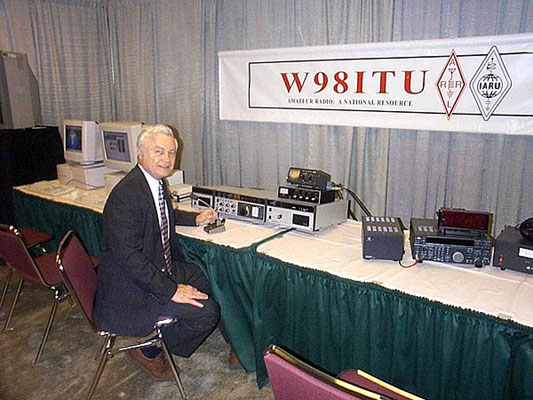 ARRL Dakota Division Director Tod Olson, K0TO, at the W989ITU Ten-Tec operating position. |
 The W98ITU QSL card. The QSL was designed by Erv Grossman, K0IVO. Photos courtesy of Tod Olson, K0TO |
W98ITU will be on the air during the day on weekdays and for entire weekends through the conference conclusion November 6. Operating hours from the Conference Center will be approximately 9 AM to 4 PM on weekdays. Because the Conference Center itself is closed at other times, regional stations operating as W98ITU have been set up in North Dakota, South Dakota, Minnesota and Wisconsin to operate evenings and weekends.
The primary W98ITU operating position controls a remote Kachina transceiver and antenna site some 18 miles west of the conference center at the QTH of Steve Fraasch, K0SF, who has a TH7 at 130 feet. A second operator position will use a Ten-Tec OMNI VI Plus, solid-state amp, and a Cushcraft vertical at the conference site. A full-fledged satellite station also is operational.
Also during the conference, the W0AIH multiop station will use the call sign N98ITU during the CQ Worldwide Contest (SSB) October 24-25. Separate, special event QSL cards will be available for those working either W98ITU or N98ITU.
QSLs for W98ITU or N98ITU go to The Plenipotentiary Amateur Radio Committee, PO Box 131415, St Paul, MN 55113. (Overseas cards may be sent via the Ninth District QSL Bureau or via the ARRL.) For more information on the main W98ITU operation at the conference center, see http://www.skypoint.com/~w98itu/index.html
Some 4000 delegates from 180 countries were expected to be on hand for this 15th ITU Plenipotentiary Conference. The Minneapolis "Plenipot" marks the first time in more than 50 years that a Plenipotentiary Conference will be held in the US. The last one on American soil was in Atlantic City, New Jersey in 1947. For more information, see http://www.itu.org/plenipot98/index.html.
BURROWING OWLS ON THE MOVE
ARRL Amateur Radio Direction Finding Coordinator Joe Moell, K0OV, says that reports from Canadian Wildlife Service biologists indicate that radio-tagged rare burrowing owls are on the move. "Now is the time to monitor for the owls!" he said.
Moell recently sought help from hams and monitoring enthusiasts to assist in tracking the migration of the burrowing owl. "We need many monitors scattered over a wide area right now," he said. The owls' radio tags transmit in the vicinity of 172 MHz. Approximately 40 owls have been tagged with transmitters, each on a slightly different frequency.
Reports from Canadian wildlife personnel indicate the owls have migrated south from Saskatchewan and Alberta A planned aircraft tracking project fell through, however, increasing the importance of ground-based volunteer monitors.
The Saskatchewan and Alberta owls are expected to fly southward through Montana, North Dakota, Wyoming, South Dakota, Nebraska, Colorado, Kansas, Oklahoma, New Mexico, and Texas. However, the exact routes and route variations are uncertain. Moell, says there's a particular need for monitors in southern Texas and northern Mexico--the anticipated wintering grounds for the Saskatchewan owls.
Those with monitoring capability living in and even around the states listed should check the owl frequencies regularly for the next month or so. Because the owls fly at night, the transmitting range at night is better than daytime.
Moell says that if you hear a signal that might be an owl radio tag, make note of the date and time, exact frequency, your location, and any other distinctive signal characteristics. But he cautions against disturbing the birds themselves, even if sighted.
Moell asks volunteer monitors to e-mail any "owl heard" reports with as much detail as possible to him at homingin@aol.com and to Canadian biologist Helen Trefry Helen.Trefry@EC.gc.ca. For more information, see the K0OV Web site, http://members.aol.com/~homingin/.
IARU REGION 2 SELECTS NEW EXECUTIVE COMMITTEE
Representatives of 24 national Amateur Radio organizations in the Americas have selected a new IARU Region 2 Executive Committee. The action came the week of September 28 during the 13th General Assembly of IARU Region 2 in Porlamar, Venezuela.
Returned to office for a second term was of IARU Region 2 President Tom Atkins, VE3CDM. Newly elected officers are Vice President Reinaldo Leandro, YV5AMH, Secretary Eduardo Estrada, HC2EE, and Treasurer Noel Donawa, 9Y4NED. Estrada and Donawa previously served on the Executive Committee as regional directors. Incumbent Vice President Ron Szama, LU2AH, remains on the Executive Committee as a regional director. All terms run three years.
Retiring officers, Secretary Pedro Seidemann, YV5BPG, and Treasurer, Steve Dunkerley, VP9IM, were honored for their many years of service to the region.
New regional directors are Rod Stafford, W6ROD, replacing Frank Butler, W4RH, who declined to run for another term after 14 years of service, and Jorge Lunkes, PT2HF. Returning as directors are Guillermo Nu-ez, XE1NJ, and Dario Jurado, HP1DJ.
The general theme of conference reports from member society was one of declining interest in Amateur Radio and declining membership in national organizations. The trend was attributed to economic difficulties and to improvements in other telecommunications facilities in many South and Central American countries. Emergency communication remains a critical need in the region and a high priority for the member societies.
The assembly adopted a proposal aimed at strengthening the connection between Region 2 and the member societies in the Caribbean, many of whom were unable to attend the conference. The assembly also resolved to support the Amateur Radio Club of Guatemala (CRAG) in its efforts to reverse its government's decision to reallocate the 70-cm. band to commercial services.
Minor amendments were made in the Region 2 HF band plans to accommodate changes in the IARU Beacon Project. Policies for coordination and liaison between the regions on beacons were adopted.
Other topics discussed and acted upon during the weeklong conference included promotion of amateur satellite communication in the Southern Hemisphere and the endorsement of efforts to seek an amateur satellite allocation near 50 MHz and primary status in VHF/UHF/SHF bands in which the amateur services are now secondary.
The assembly thanked retiring Region 2 News editor Fred Laun, K3ZO, and his wife Somporn for their years of devoted service editing and publishing the bilingual publication. Also commended were retiring Region 2 Beacon Coordinator John G. Troster, W6ISQ, and Monitoring System Coordinator Malcolm Hamon, VE3KXH.
Radio Club Venezolano hosted the Porlamar meeting. Special event station YV7AJ was on the air from the meeting site and made hundreds of contacts. The next General Assembly of IARU Region 2 will be held in Guatemala in 2001.
THE 1999 ARRL HANDBOOK FOR RADIO AMATEURS
The 1999 edition of The ARRL Handbook for Radio Amateurs begins shipping later this month. Last year's edition sold out, so consider ordering early. The 1999 Handbook includes several new projects, including a 40-A switching power supply, an HF amplifier (using a Svetlana 4CX1600B), an updated high-power antenna tuner, and a voice keyer.
Templates are back in this edition, too! Builders will find most of the circuit board templates available.
Published since 1926, this 76th edition of the Handbook continues its longstanding reputation as the standard in applied electronics and communications, used by radio amateurs and professionals alike. The 1200-page resource for electronic theory, data, and new projects is revised annually.
The 1999 edition of The ARRL Handbook for Radio Amateurs is still just $32. Order item 1816. Call toll-free 888-277-5289 or visit ARRLWeb, http://www.arrl.org/catalog/1816/.
By the way, the 1998 edition of the Handbook remains available on CD-ROM!
SOLAR UPDATE
Propagation prognosticator Tad Cook, K7VVV, Seattle, Washington, reports: Solar activity was up a little last week, with the average sunspot number increasing 42 points to 95, and the average solar flux rising just over three points to 119.7. Solar flux is rising, and conditions should be great this weekend for the RSGB 21/28 MHz CW Contest. Predicted solar flux for October 16-18 is 135, 140 and 140, and the predicted planetary A index is 5, 5, and 8. With the rising solar flux, low geomagnetic activity and the fall season upon us, 10 and 12 meters are good right now, particularly at lower latitudes.
Solar flux should begin to fall after October 20, going below 130 again around October 24 and below 120 a few days later. The geomagnetic field is expected to remain quiet to unsettled.
VE9AA in New Brunswick reported that he and other hams in VE2 and VE3 reported hearing weak 48.25 MHz video signals from Europe around 1330-1430 UTC on October 11. On October 14 WP4O in Puerto Rico worked LW5EJU in Argentina on both 6 and 2 meters.
Sunspot numbers for October 8 through 14 were 146, 125, 94, 68, 76, 70, and 86, with a mean of 95. The 10.7-cm flux was 124.1, 123.5, 120.7, 118.9, 113.9, 118.1, and 119, with a mean of 119.7. The estimated planetary A indices were 17, 16, 10, 8, 6, 7, and 4, with a mean of 9.7.
JULES WENGLARE, W6YO, SK
Veteran DXer and DXpeditioner Jules Wenglare, W6YO, of Delano, California, died July 16. He was 87. First licensed as W8DVS in 1930, Wenglare is said to be the first ham to work and confirm 100 countries while running less than 100 W. He held DXCC certificate No. 23 and had 356 countries confirmed at the time of his death. A World War II veteran, he spent most of his service in the Army Airways Communications System (AACS) doing transmitter maintenance. Over the years, he'd operated from 45 countries, either as a guest operator or with his own call signs, including TA3AA, YI4LIU, SV6AA, FH0YO, and ZD7YO. He was a charter member of the Central California DX Club, an ARRL member for 26 years, and a regular on the AACS nets. --thanks to Ed Evans, W5LK
WILLIAM C. WELLS, WA8HSU
William C. Wells, WA8HSU, of Logansport, Indiana, died September 22. He was 50. Wells was well-known within the frequency-coordination community and, at the time of his death, was a founder and the technical and coordination director of the Midwest Spectrum Management Alliance. He was a member of the ARRL and of the Cass County Amateur Radio Club. He also had served as assistant director of communications for the Cass County Emergency Management Agency. Services were September 26.
In Brief:
- This weekend on the radio: The Jamboree on the Air (JOTA), the JARTS WW RTTY Contest, the QRP ARCI Fall QSO Party (CW), the Illinois QSO Party, the RSGB 21/28 MHz Contest (CW), the Worked All Germany (WAG) Contest (see http://www.darc.de/referate/dx/fgdcg.htm) and the YLRL YL Anniversary Contest (SSB) are on tap this weekend.
Just ahead: The CQ WW DX Contest (SSB) is October 24-25. The BARTG RTTY Sprint is October 31. - AMSAT Annual Meeting special event: The Vicksburg (Mississippi) Amateur Radio Club is sponsoring special event station K5ZRO on HF, VHF and satellite during the 16th AMSAT Annual Meeting and Space Symposium October 17 and 18. Operation will be on 7.245, 14.245, 21.345 and 28.445 MHz, plus 146.520 MHz (FM simplex). Satellite operation will include AO-10, AO-27, RS-12/13, FO-20 and FO-29. QSL via Ed Magruder, N5QDE.--AMSAT News Service
- Hams pass word on quake: Amateur Radio was the link to the outside world after an earth tremor hit Belgrade and central Serbia September 30. The quake, measuring 5.4 on the Richter Scale, caused minor damage. Amateur Radio reports said pajama-clad residents ran into the open clutching children, but seismologists advised within two hours that it was safe to go back inside. The tremor knocked out power in some parts of Belgrade. No one was reported hurt.
- France simplifies reciprocal permit: France no longer requires a temporary operating permit for visits of up to 90 days on French soil, and there is no longer any charge. Formerly, applicants had to pay a fee of 100-francs (around $18) and wait a few weeks for a license. Now, no special notification is necessary. The only "catch" is that operators are supposed to identify using both the required French prefix as well as a /P suffix (eg, FP/W1AW/P), making for a cumbersome call sign!--thanks to Gerard Valadier, N2BFL
- Patty wins again: Country songstress Patty Loveless, KD4WUJ, recently took home the Country Music Association's Vocal Event award for her hit single "You Don't Seem to Miss Me," recorded with special guest artist George Jones. This marks her fourth award from the Country Music Association.--thanks to Newsline
- Me too! Mike Endres, WH6J, of Tavares, Florida, says Warren Offutt, AF9Q, of New Mexico, is not the only ham to have an "orbiting rock" named after him (see The ARRL Letter, Vol 17, No 11, or May QST, page 75). Endres says he's got one too. The asteroid is 7361 Endres, discovered March 15, 1996, orbiting just beyond Mars. He says NASA/JPL's Eleanor "Glo" Helin ("Ms Comet" to the astronomical community, according to Endres) named the asteroid after him. He said the naming followed his 18-month long effort as site manager for the GEODSS Tracking Site on Maui to convince the Air Force to allow NASA/JPL to use the GEODSS telescopes for near-Earth orbit asteroid searches during the dark of the moon. "The effort was tremendously successful," he said, and 7361 Endres was the first asteroid discovered after NASA/JPL instituted the NEAT Project. NEAT has its own home page at http://huey.jpl.nasa.gov:80/~spravdo/neat.html. Endres has retired and moved to Florida but says he keeps "a keen interest in things astronomical."
- Light trucks get equal plates in Rhode Island: Light trucks in Rhode Island now are eligible to carry Amateur Radio call sign license plates. L. Dean Whitsett, N1SXL, of Hope Valley, Rhode Island, says that after he was unable to get ham plates on his own truck, he enlisted the help of state Sen. Barbara Walsh, to change the law. The revised statutes now permit ham plates on passenger and commercial vehicles under 9000 pounds gross weight. Ham plates are eligible to all but Novice ops in Rhode Island.
- SOHO nearly back in business: High-quality new pictures of the sun, taken earlier this week from the Solar and Heliospheric Observatory (SOHO), have raised hopes that the mission may soon be returned to scientific operations. Engineers have successfully reactivated 9 of the 12 instruments on the European Space Agency/NASA SOHO mission, which has been out of commission for nearly four months after contact was lost on June 24. Images from the Michelson Doppler Imager and the Extreme Ultraviolet Imaging Telescope on SOHO are posted at http://sohowww.nascom.nasa.gov--NASA