ARRL Audio News
| · | To subscribe, unsubscribe, or change your e-mail delivery address: see How to Get The ARRL Letter, below |
| · | Delivery problems (ARRL member direct delivery only!): letter-dlvy@arrl.org |
| · | Editorial questions or comments: Rick Lindquist, N1RL, rlindquist@arrl.org |
| · | ARRL Audio News: http://www.arrl.org/arrlletter/audio/ or call 860-594-0384 |
| · | The ARRLWeb Extra: http://www.arrl.org/members-only/extra |
IN THIS EDITION:
- +Live SSTV transmitted from Mir
- +FCC acts in alleged exam, license fraud cases
- +Sputnik 41 QRT
- +ARRL comments in Part 15 proceedings
- FAR offers scholarships
- Fifteen days of virtual fame!
- Solar update
- Luke H. "Jack" Montgomery Jr, WA4UDB, SK
- Richard A. Bernstein, KA2YZM, SK
- Homer J. "Joe" Johnson, W5QFU, SK
- In Brief: This weekend on the radio; New OK SM; Vanity update; SM training session; Satellites get OSCAR assignments; DARA scholarships; Antarctica call signs clarified
+ Available on ARRL Audio News
LIVE SSTV TRANSMITTED FROM MIR
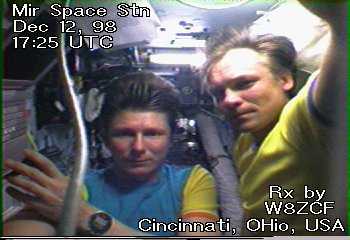 The Mir crew, Gennady Padalka and Sergei Avdeyev, via SSTV, as received by Farrell Winder, W8ZCF.
 |
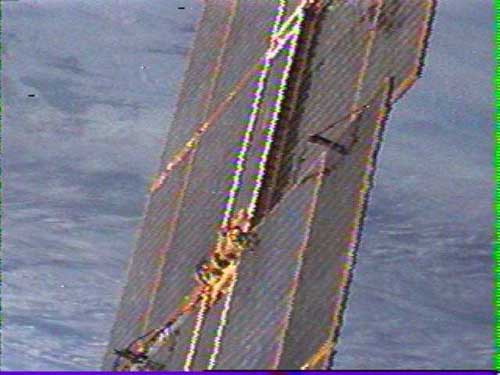 An SSTV shot of the Mir solar panels, as received December 16 at W1AW.
 |
For the first time, live SSTV images have been transmitted from the Russian Mir space station. SSTV equipment was transported to the spacecraft earlier this fall and put on the air December 11. Several amateurs reported copying the images from space on 2 meters, but plans call for the SSTV transmissions to move to a 70-cm frequency that's coordinated for that purpose.
The SSTV system was turned off for several passes after December 14, and the Mir packet system was back on 145.985 MHz, but as of December 16, R0MIR was transmitting SSTV on some passes and packet on others. Meanwhile, APRS developer Bob Bruninga, WB4APR, had announced a four-day APRS school experiment via Mir through December 18.
Maxim Memorial Station W1AW copied R0MIR's SSTV pictures December 14 and 16 on 145.985 MHz. "We were able to see one of the solar panels and part of what appeared to be the lower outline of the spacecraft," said W1AW Station Manager Joe Carcia, NJ1Q. He added that Mir's signal was "pretty strong, a good 58 or 59 for most of the pass." Before the SSTV transmission commenced, the station sent "R0MIR" in CW.
Neither of the cosmonauts aboard Mir during the current tour of duty is a licensed amateur. The SSTV equipment aboard the spacecraft was supplied to the Russians by Miles Mann, WF1F. He says the system operates in automatic mode and can display a new image every two minutes.
Mann coordinated a 70-cm frequency, 437.975 MHz, for the SSTV project with AMSAT Frequency Coordinator Graham Ratcliff, VK5AGR. The 2-meter 145.985 MHz frequency has been coordinated for FM voice and packet use, however. While the SSTV system is operating, the Mir packet system and the SAFEX repeater are off the air. Mann said December 16 that he's seeking to keep the SSTV system operating on 2 meters for a while longer, but added that it would likely go to 70 cm on or before January 1.
A former Mir International Amateur Radio Experiment (MIREX) vice president, Mann formed his own Manned Amateur Radio Experiment--North American division (MAREX-NA) organization after a public falling out with MIREX President and Mir packet sysop Dave Larsen, N6CO. Larsen, the official Space Amateur Radio EXperiment (SAREX) liaison with the Russian space program, was among those complaining about the appearance of SSTV on Mir's 2-meter downlink frequency.
For details on how to receive SSTV using your PC, see http://www.ultranet.com/~sstv.
FCC ACTS IN ALLEGED EXAM, LICENSE FRAUD CASES
The FCC's Compliance and Information Bureau has acted in several Amateur Radio cases it inherited from the days when it shared enforcement duties with the Wireless Telecommunications Bureau. In all of the cases, the FCC said it appeared that individuals attempted to obtain an Amateur Radio license or upgrade by fraud or misrepresentation.
On December 14, the FCC downgraded two amateur licensees and canceled the ticket of a third in Michigan. Busted from Advanced to Tech Plus were Lawrence A. Repp Jr., N8HFN, of Gaylord, and Alan E. Quirie, KA8ZRR, of Royal Oak. The FCC pulled the Tech Plus ticket of Steven A. Penn, formerly KC8HUM, of Southfield. The FCC had not updated its database as of December 15.
The Commission said the three filed amateur applications claiming to have taken Amateur Radio examinations at Oak Park June 3, 1997, at an ARRL VEC session. The FCC says its evidence shows that the three did not sit for the exams and that their names "were added and signatures forged, sometime after the tests were administered, by one of the four examiners." That examiner--the father of one of the exam candidates involved--is said to have forwarded the session package on behalf of the VE team to the ARRL VEC for FCC filing.
"Three of the examiners knew nothing of the scheme," the FCC said. The other three VEs brought the situation to the attention of the ARRL VEC and the FCC after learning that names had been added to the list and that their names had been forged on the ARRL VEC Administering VEs Record. The FCC said it would act in the case of the fourth examiner by month's end. The Commission also is looking into possible enforcement action against another ham whose name was added to the list after the test session but whose application was not actually submitted to the FCC.
The FCC also dismissed two amateur applications in Puerto Rico after the applicants failed to answer questions put to them by the Commission. In the case of Jose R. Velez-Rivera, of Rio Pedras, an FCC official said it appears that an imposter tried to change another amateur's call sign, address, and date of birth to his own to get a license without taking an exam. In the second case, the FCC dismissed the renewal and General class upgrade application of Hector A. Santiago, WP4DCB, of Camuy. An FCC official said it appears Santiago tried to renew as a General when he only had a Novice ticket.
Velez-Rivera and Santiago were notified by the FCC October 23. The FCC updated its database this month to reflect the dismissals.
SPUTNIK 41/RS-18 QRT
The second mini-Sputnik satellite, Sputnik 41, went silent on or about December 11, according to reports. The little satellite, also known as RS-18, was launched by hand from the Russian Mir space station during a November 10 space walk by cosmonauts Gennady Padalka and Sergei Avdeyev.
Sputnik 41 was powered by nonrechargeable batteries and designed to operate for up to a month. Its predecessor, Sputnik 40--launched in November 1997 to commemorate the launch of the original Sputnik satellite in 1957--continued to transmit for 55 days. The later Sputnik 41/RS-18 transmitted recorded voice beacons in English, Russian, and French as well as a beacon tone that indicated the satellite's interior temperature.
Sputnik 41 was financed by the Aeroclub de France to mark its centennial as part of a program of satellites made in a collaboration of Russian and French students. AMSAT-France cooperated with the education department of the Russian Aeronautic Federation in this most recent Sputnik reprise.
Reception reports go to AMSAT-France, Sputnik 41/RS-18 QSL Manager, 14 bis rue des Gourlis, 92 500 Rueil-Malmaison, France. Reports should include a 5x7, self-addressed envelope and two IRCs.
An updated list of reception reports received by the French QSL manager is available at http://ourworld.compuserve.com/homepages/ ascerland/sp41QSL.htm. The page lists reception reports from some 40 countries around the world.
For more information, visit the 1998 International Year of Air and Space page, http://www.ccr.jussieu.fr/physio/Satedu/sputnik41.html.
ARRL COMMENTS IN PART 15 PROCEEDINGS
The ARRL has filed comments with the FCC in two proceedings that it says could lead to greater interference to amateurs.
The League expressed "continued strenuous opposition" to an FCC proposal to revise Part 15 of the rules to permit unlicensed, point-to-point transmitters in the 24.05 to 24.25 GHz band at field strengths of up to 2.5 V per meter, measured at 3 meters. Amateur Radio has an allocation at 24.0 to 24.25 GHz.
In September, the FCC released a Notice of Proposed Rule Making in ET Docket 98-156, in response to a petition from Sierra Digital Communications Inc. The company wants to market point-to-point microwave devices. The ARRL already had commented on the Sierra Digital Petition for Rule Making. It called the FCC's proposed rules changes "entirely inappropriate for Part 15 unlicensed facilities."
The League said the Commission considered and denied a petition in 1983 to permit unlicensed, uncoordinated, point-to-point microwave operation in the 24-GHz band. The recent petition amounts to "the exact same proposal," the League said.
The League also commented in response to a Notice of Inquiry, in ET Docket 98-153, about whether the FCC should revise Part 15 to allow ultra-wideband (UWB) transmission systems. Such systems, operating in the VHF and UHF spectrum, include applications like radar, voice, data, and control communications devices. The League expressed concerns that Amateur Radio and home entertainment devices, including TV sets, could be subjected to interference from the Part 15 UWB devices.
The League proposed that the Commission ask manufacturers of UWB devices to develop and circulate technical standards "in support of a unified, comprehensive plan." The League also offered its services to help determine proper technical regulations.
FAR OFFERS SCHOLARSHIPS
The nonprofit Foundation for Amateur Radio Inc--an ARRL-affiliated federation of more than 75 Amateur Radio clubs in the Washington, DC, area--plans to administer 66 scholarships for the 1999-2000 academic year to help licensed radio amateurs with their post-secondary education. Ten of the scholarships are fully funded with income from grants and the foundation's annual hamfest. FAR administers the remaining 56 scholarships without cost to the donors.
Licensed amateurs are eligible to compete for these awards if they plan to pursue a full-time course of study beyond high school and are enrolled in or have been accepted at an accredited university, college, or technical school. Awards range from $500 to $2500. In some cases, preference goes to those pursuing certain courses of study or to residents of specific geographical areas. FAR encourages all clubs, especially those in Delaware, Florida, Maryland, New Jersey, Ohio, Pennsylvania, Texas, Virginia, and Wisconsin, to spread the word on the availability of these scholarships.
Application forms and additional information are available by letter or QSL postmarked prior to April 30, 1999, from FAR Scholarships, PO Box 831, Riverdale, MD 20738. Contributions to FAR are tax-deductible.
FIFTEEN DAYS OF VIRTUAL FAME!
Imagine your feature article on the pages of our new Web publication, The ARRLWeb Extra! We invite your Amateur Radio-related non-technical, semi-technical, entertaining, informative, innovative, and even off-the-wall articles for consideration. Good-quality photographs and sound files to complement your article are encouraged.
Developing an idea or (better yet) a series of ideas you'd like to share with your fellow ARRL members? Maybe we can sign you on as a regular AWE contributor. Are you an unsung (and unparalleled) columnist for your local club newsletter seeking a wider audience? Let's talk! Have a useful ham radio tip you'd like to pass along? Send it! We compensate authors for material we use. You won't get rich, but you will get your name up in lights (in a manner of speaking, that is) for a couple of weeks.
We're also always looking for captivating and imaginative Amateur Radio-related photos, hard copy or electronic. Get in touch with Rick Lindquist, N1RL, Senior News Editor, ARRL HQ, e-mail n1rl@arrl.org or tel 860-594-0222.
SOLAR UPDATE
Solar seer Tad Cook, K7VVV Seattle, Washington, reports: Solar activity was mixed this week, with sunspot numbers up an average of about 10 and solar flux down about 9 points compared to last week. The average solar flux for the previous 90 days rose from 131 to 132, and solar flux was above this level on every day, a good indicator of a general upward trend. The active geomagnetic day was December 11, when the Planetary A index rose to 30 and the College, or high latitude A index was 52. This indicated a geomagnetic storm.
Conditions were good for the ARRL 10-Meter Contest, even with the rough conditions at the start. Solar flux was higher than forecast, with the December 11-13 numbers at 143.1, 143.3 and 144.2, rather than the predicted 132, 128 and 122.
This bulletin is written on December 17, and geomagnetic conditions have been exceptionally quiet, with an A index of zero. The Boulder K index was also zero throughout the day, and the College and Planetary K index only showed marginal activity around 1500 and 1800 UTC. Over the next three days, December 18-20, the predicted Planetary A index is nine, and the solar flux should be around 145, 140 and 135. Beyond the weekend expect the solar flux to rise back to 150 around December 28 and 29, then drift below 145 again on the last day of the year, rising slightly again the second week in January. Look for slightly unsettled conditions around December 28 and 29.
There were some interesting conditions on VHF this past week. On December 11, while the geomagnetic storm was disrupting propagation on HF, ZL3SIX in Christchurch was hearing many North American stations on 6 meters, including N5JHV and two Mexican beacon stations. Also, VK3AMK worked TI5KD and SM0KAK/XE1 worked VK7GK on 50 MHz. On 2 meters, WA6TBO heard the KH6HME beacon, and WP4O reported working Uruguay from Puerto Rico.
Sunspot numbers for December 10 through 16 were 145, 166, 142, 152, 113, 108, and 118 with a mean of 134.9. The 10.7-cm flux was 133.8, 143.1, 143.3, 144.2, 144.4, 141.6, and 140.5, with a mean of 141.6. The estimated planetary A indices were 6, 30, 6, 3, 4, 5, and 11, with a mean of 9.3.
LUKE H. MONTGOMERY JR, WA4UDB, SK
Luke H. "Jack" Montgomery Jr, WA4UDB (ex-W4ADF), of Nashville, Tennessee, died October 12. He was 91. Montgomery and Jack DeWitt founded WSM radio in 1922, and Montgomery engineered the first broadcast of the Grand Ole Opry in 1925. He served as chief engineer at WSM radio and later at WSM television. He build the first commercial FM station in the US in 1938. Montgomery became the son-in-law of George Bailey, W2KH, who served as ARRL president from 1940 until 1952. Beyond radio engineering, Montgomery served as a research associate and later as an assistant professor of anatomy at the Vanderbilt University School of Medicine. He was an early pioneer of the pacemaker (among other developments) and was named a Fellow of the Institute of Radio Engineers for his contribution to medical electronics. Survivors include his stepson, Dick Crouch, N6RC.--Dick Crouch, N6RC
RICHARD A. BERNSTEIN, KA2YZM, SK
Rich Bernstein, KA2YZM, of Tamarac, Florida, died December 11. He was 51. An ARRL member, Bernstein was the net manager of the Florida Midday Traffic Net and the Broward County Emergency Preparedness Net. Southern Florida Assistant SEC Jim Goldsberry, KD4GR, reports that Bernstein suffered from Crohn's disease. "He was admired by all who knew him for his persistence in continuing to serve as net manager for FMSN and BCEPN, plus being active in ARES/RACES despite his medical problems," he said. Goldsberry said some 20 hams attended services for Bernstein December 14. --Jim Goldsberry, KD4GR
HOMER J. "JOE" JOHNSON, W5QFU, SK
Arkansas Section Traffic Manager Joe Johnson, W5QFU, died December 12. He was 81. Johnson lived in Malvern, Arkansas, and had been an ARRL member for 31 years.--Roger Gray, N5QS
In Brief:
- This weekend on the radio: The Croatian CW Contest is December 19-20.
Just ahead: The Stew Perry Topband Distance Challenge and the RAC Winter Contest are December 26-27. - New OK SM: Charlie Calhoun, K5TTT, has been appointed Oklahoma Section Manager. He replaces Coy Day, N5OK, who takes office as West Gulf Division Vice Director January 1, 1999. Calhoun's term as SM ends September 30, 2000.
- Vanity update: The FCC in Gettysburg reports it has processed vanity applications received through November 27. The latest run yielded 184 grants. Another 174 applications landed in the work-in-process or WIPs stack.
- SM training session: ARRL HQ hosted five new section managers on December 5 for a daylong Section Managers' Workshop, conducted by Field Services Manager Rick Palm, K1CE. Attending were Raul Escobar, KP4ZZ, Puerto Rico; George Tranos, N2GA, New York-Long Island; Bob DeVarney, WE1U, Vermont; Kevin Bunin, K4PG, Southern Florida; and Les Shattuck, K4NK, South Carolina. Palm says the workshop included the SM's program responsibilities, issues and discussion, plus ARRL organizational mission and structure; basic management theory; and volunteer motivation techniques.
- Satellites get OSCAR assignments: Amateur Radio's two newest satellites, SEDSAT-1 and PANSAT, have been assigned OSCAR numbers by AMSAT. SEDSAT-1 now is SEDSAT OSCAR-33 or SO-33, while PANSAT is PANSAT OSCAR-34 or PO-34. Both were launched earlier this fall. AMSAT President Keith Baker, KB1SF, congratulated members of the SEDSAT and PANSAT teams on their success in placing their respective satellites into orbit. The assignment of consecutive OSCAR numbers to new ham radio satellites dates from the launch of OSCAR-1. To qualify for an OSCAR number, the satellite must successfully achieve orbit and one or more transmitters must be successfully activated in the Amateur Radio bands.--AMSAT News Service
- DARA scholarships: The Dayton Amateur Radio Association is accepting applications for its annual scholarship awards. The DARA Scholarship Program is open initially to any Amateur Radio operator graduating from high school in 1999. There are no restrictions on course of study, nor does the student need to be pursuing a four-year baccalaureate degree, but schools selected must be accredited. Awards are made on a nondiscriminatory basis. Selection criteria include financial need, scholastic achievement, contributions to Amateur Radio, and community involvement. Decisions of the DARA Scholarship Committee are final. Maximum individual awards are $2000. For an application and full details, send an SASE to DARA Scholarships, 45 Cinnamon Ct, Springboro, OH 45066. Application deadline is June 15, 1999.--Stan Kuck, NY8F
- Antarctica call signs clarified: The call sign blocks for US operations in Antarctica are KC4AAA-AAF and KC4USA-USZ. These call signs are not issued nor administered by the FCC but by either the National Science Foundation (AAA-AAF) or the US military (USA-USZ). As a result, Antarctica call signs do not appear in the FCC database. More information is available at http://www.qrz.com/.--thanks to John Hennessee, N1KB, ARRL Regulatory Information Branch