ARRL Audio News
| · | To subscribe, unsubscribe, or change your e-mail delivery address: see How to Get The ARRL Letter, below |
| · | Delivery problems (ARRL member direct delivery only!): letter-dlvy@arrl.org |
| · | Editorial questions or comments: Rick Lindquist, N1RL, rlindquist@arrl.org |
| · | ARRL Audio News: http://www.arrl.org/arrlletter/audio/ or call 860-594-0384 |
| · | The ARRLWeb Extra: http://www.arrl.org/members-only/extra |
IN THIS EDITION:
- +FCC shuts down troublesome Frisco repeater
- +SUNSAT launched--finally!
- +Texas hams go for state PRB-1 law
- +Ohio hams aid search for missing child
- +Hams still on hold for ULS
- Charges dismissed in Godsey case
- W4EHW ops commended
- Solar update
- In Brief: This weekend on the radio; Emergency request ; Vanity update; Contest Yearbook discontinued; Riley Hollingsworth to do Dayton; More ham radio in the cinema? Burundi (9U) contacts disallowed; AMSAT-NA 30th anniversary party
+Available on ARRL Audio News
FCC SHUTS DOWN TROUBLESOME BAY AREA REPEATER
The FCC has shut down for 120 days the K7IJ repeater facility on Grizzly Peak in the San Francisco Bay area and told the licensee his ham ticket could be in jeopardy. The FCC took the action by modifying K7IJ's license to prohibit repeater operation starting midnight February 28, 1999. The repeater operates on 145.29, 223.78, 440.175, and 441.175 MHz. The FCC also set aside recent license grants of four individuals accused of unlicensed operation on the repeater prior to obtaining their amateur tickets or of other behavior. The cases, the first major VHF/UHF enforcement actions the FCC has taken in recent months, were brought to the Commission's attention by the Amateur Auxiliary.
The FCC's Riley Hollingsworth, K4ZDH, said that for almost a year, the repeater's control operator, identified as Blake B. Jenkins, N6YSA, of Berkeley, California, "has apparently not only allowed, but encouraged, use of the repeater by unlicensed operators, rebroadcast of cordless telephone calls, playing of music, and profanity and obscenity." He said extended QSOs have taken place between the control operator and unlicensed stations.
Hollingsworth said the situation was brought to the attention of the licensee, Bruce Wachtell of Carson City, Nevada, but nothing was done. "Such operations are not only contrary to the Amateur Radio Service rules and frequency allocations, but degrade the service for legitimate radio licensees as well," Hollingsworth said in a certified letter to Wachtell February 25. "The operation of the K7IJ repeater system in this manner may reflect adversely upon your qualifications to hold a Commission license."
Hollingsworth said Jenkins' "actions and omissions" while control operator were under separate FCC review, along with those of the secondary control op, Steven R. Rossi, KE6LNH, of Novato, California. The FCC set aside the recent license grants or upgrades of James C. Walker, KF6VAA; Gordon B. Reese III, KF6QKA; Michael J. Nichols, KF6UAS; and Eric B. Shuler, KF6BMG (ex-KF6UJU) pending further investigation. The FCC has permitted Reese, who just upgraded to Tech Plus, to retain his Technician operating privileges while its investigation continues.
The FCC also warned Mervyn Ehambrave of E Palo Alto, California, about unlicensed operation on the K7IJ repeater, and warned Timmy O Sheen Sr, N6MZA, about behavior including "jamming and rebroadcasts of cordless phones" on the repeater, Hollingsworth said.
SUNSAT LAUNCHED--FINALLY!
After more than a month of delays and aborted launch attempts, the Delta II rocket carrying the South African SUNSAT Amateur Radio satellite and other payloads lifted off February 23 from Vandenberg AFB in California. Early reports indicate that the SUNSAT payload deployed and the ground team has communicated with the satellite and monitored telemetry. "SUNSAT relayed the temperature of both its top and bottom plates," the team reported. "Both temperatures were quite low, which is good for the condition of the batteries." SUNSAT should be fully operational in about a month, according to the SUNSAT team.
Because of weather and technical glitches, the Delta II launch carrying the Advanced Research and Global Observation Satellite (ARGOS) primary payload as well as SUNSAT and the Danish OERSTED satellite was put off numerous times since its originally scheduled January 14 launch date.
SUNSAT, which stands for Stellenbosch University Satellite, takes its name from the South African university whose students constructed the payload. Stellenbosch professor Garth Milne, ZR1AFH, is heading up the effort.
The SUNSAT package includes digital store-and-forward capability and a voice "parrot" repeater that will be used primarily for educational demonstrations. The unit has two VHF and two UHF transmit-receive systems. For more information on SUNSAT, visit http://sunsat.ee.sun.ac.za.
TEXAS HAMS MOUNT PRB-1 EFFORT
At the request of radio amateurs, a bill was introduced in the Texas House of Representatives to incorporate the essence of the limited federal preemption, PRB-1, into state law. The measure, HB 1345, was introduced by State Rep Patricia Gray at the request of Karl Silverman, N0WWK. Silverman is president of the Johnson Space Center Amateur Radio Club.
The bill would amend the Local Government Code in Texas to prevent local jurisdictions from enacting or enforcing ordinances that fail to comply with PRB-1. The bill further would require ordinances dealing with Amateur Radio antenna placement, screening, or height based on health, safety or aesthetics to "reasonably accommodate amateur communications" and "represent the minimal practicable regulation to accomplish the municipality's or county's legitimate purpose."
A hearing on the bill before the Land and Resource Management Committee is set for March 1. Silverman is scheduled to speak on behalf of the bill, and other speakers also might have an opportunity as well.
A letter Silverman circulated to Texas clubs to gain their support for the measure cites the success of Virginia hams in passing the nation's first and only specific tower protection bill. Silverman's appeal asks hams to contact the governor and state lawmakers to express support for the pending legislation. He's also asked Texas hams to turn out for the committee hearing March 1 (8 AM CST, Room E2030, Capitol Building).
Last year, the Plano Amateur Radio Klub (PARK) was instrumental in negotiating a amateur tower compromise in that Texas city in the wake of concerns over Amateur Radio antennas and interference. The compromise would permit 50-foot towers or units that could be cranked up to 75 feet while in use without requiring a special-use permit.
OHIO HAMS HELP SEARCH FOR MISSING GIRL
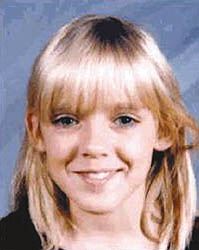 Erica Nicole Baker, age 9, missing
from Kettering, Ohio, February 7. She is 3'-11", 65 pounds,
blond hair, hazel eyes.
Erica Nicole Baker, age 9, missing
from Kettering, Ohio, February 7. She is 3'-11", 65 pounds,
blond hair, hazel eyes. |
Hams in Ohio's Miami Valley helped to search for a nine-year-old girl reported missing February 7. Erica Nicole Baker of Kettering failed to return home after walking the family dog near the Kettering Recreation Complex. The dog was found--still wearing its leash--about three hours later.
The youngster's parents are separated. Erica's father had dropped her off at her mother's home the afternoon of February 7. She was last seen in the park wearing a pink raincoat, a Winnie the Pooh sweatshirt, and blue jeans. An official search, which included search dogs and involved dragging, then draining, a pond near the park complex, turned up empty-handed.
The Dayton Amateur Radio Association van, the Warren County Mounted Search Team, and RACES were called in to aid with the search February 11. Hams from Warren, Greene, Montgomery, Clark, and Darke counties aided police, fire, and search teams by providing communication in the field and maintaining posts around the search perimeter.
The search was expanded to cover a 150-square-mile area around the rec complex. Miami Valley Urban Search and Rescue Team asked the DARA van to return February 12 to serve as command post support at the Germantown Dam Reserve. A decision also was made to use HF and packet instead of the well-monitored VHF and UHF repeaters, to minimize eavesdropping. Among those assisting was ARRL Great Lakes Director Dave Coons, WT8W.
As of February 25, Erica remained missing, according to Kettering Police. Her disappearance has been the subject of episodes on America's Most Wanted. Anyone having information on the missing girl is asked to call the Kettering Police, 937-296-2570.--Bev Priest, N8VZV
HAMS STILL ON HOLD FOR ULS
While the FCC's Wireless Telecommunications Bureau began using the Universal Licensing System (ULS) February 16, hams remain in a holding pattern on ULS until the FCC establishes a ULS Amateur Service database. That's not expected to happen until later this year. This means that hams still must use Form 610 and its variations. These so-called "pre-ULS forms" are valid until further notice. On-line services are limited to Form 900 renewals within 120 days of expiration and Form 610V vanity call sign application. License modifications are not yet available on-line unless done at the same time as a renewal.
The ULS is a new, interactive licensing database that consolidates and replaces 11 existing databases and licensing systems, including the Amateur Service. Among other things, it will replace the venerable FCC Form 610 series with a new Form 605 and provide on-line filing, modification, and renewal for amateurs.
In January, the ARRL petitioned the FCC for minor alterations to the ULS rules. The League said it wants the FCC to continue to issue paper license documents; to come up with a way for applicants not having a Taxpayer Identification Number--typically a Social Security Number--to meet ULS requirements to provide one; and to include on Form 605 a section for Volunteer Examiners to certify that an applicant has met the requirements for a new or upgraded ham ticket.
The FCC subsequently did make provisions to assign TINs to those doing business with the Commission who have no legal way to obtain one. The "assigned" TINs will consist of the letter "A" followed by eight digits. They will not be available to those eligible to hold a Social Security Number. Alien licensees needing an assigned TIN should contact FCC Technical Support at 202-424-1250.
Prior to its latest filing, the ARRL had expressed concerns that the FCC might do away with paper license documents altogether and rely instead on the "license grant"--the virtual document that resides within the FCC's computerized amateur database. The League pointed out in its January petition that some states regulate possession of scanning receivers but exempt amateurs, and inability to produce a license document could result in "arrest and criminal prosecution as well as seizure of equipment by local law enforcement." The League said hams operating overseas also often must produce a paper document. The ARRL noted that the CEPT agreement requires US hams traveling in CEPT countries to possess a US government-issued license document and that ITU regulations "appear to require" a government-issued license document.
CHARGES DISMISSED IN GODSEY CASE
It took more than two years, but all charges against a Kentucky ham for impersonating a public servant and disorderly conduct finally were dropped in December. Greg Godsey, KF4BDY, of Hopkinsville, was just shy of his seventeenth birthday when he was arrested by police in his hometown.
At the time of his arrest, Godsey was active in ARES as Christian County EC. He claims the impersonation charge stemmed from his ARES association. Police also had charged Godsey with carrying a scanner capable of receiving police frequencies and confiscated his Radio Shack HTX-202. The scanner charge reportedly was dismissed in court the following month, and his H-T was returned to him. The other charges had remained on the court docket, however.
Godsey, now 19, said the charges were dropped in December after both sides agreed to not sue anybody over the matter. Godsey says he and his family spent more than $3000 fighting the charges against him.
W4EHW OPERATORS COMMENDED
Operators at W4EHW ("Early Hurricane Warning") at the National Hurricane Center in Miami have been honored by the National Hurricane Center. The 30 operators received Certificates of Commendation in late January, presented by NHC Deputy Director Max Mayfield. He expressed his thanks for the operators' commitment and dedication in supporting the Center's staff.
NHC Director Jerry Jarrell says ham radio volunteers play an important role in storm forecasting and tracking. "Despite all the technological advances in satellite imagery and modern hurricane hunter airplanes, the hams many times are the only ones that can tell us what is actually happening on the ground, and, for this we are grateful," he said.
Volunteer amateurs have been donating their time and equipment to the National Hurricane Center for nearly 20 years now, helping to gather weather and storm data from hams along the US coast and throughout the Caribbean. During the busy 1998 season, W4EHW operators logged more than 180 hours for Hurricane Georges and nearly 90 for Hurricane Mitch--plus many hours for other storms. During Georges, W4EHW received nearly 500 reports by Amateur Radio, fax or the Internet. Hurricane forecasters use data received from amateurs via W4EHW as an aid in preparing their forecasts.
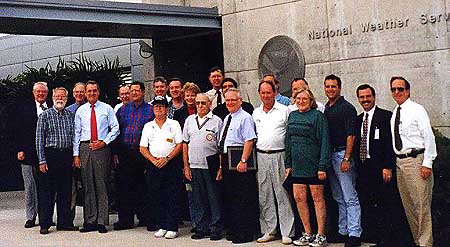 W4EHW operators outside the National Hurricane Center in Miami.
 |
According to the NHC Coordinator for Amateur Radio John McHugh, KU4GY, Amateur Radio support to the Center began humbly during the 1980 hurricane season. "Julio Ripoll, WD4JNS (now W4EHW assistant coordinator), carried a borrowed HF radio in a cardboard box to and from the Center whenever a storm threatened," he recalled. "He set it up on a forecaster's desk, ran a wire antenna, and with a crew of five volunteers, operated for 12-hour shifts."
Today W4EHW sports a donated state-of-the-art station that includes HF, VHF, and UHF radios, six antennas and two computers that handle APRS and Internet communication. The 30 volunteers typically work three-hour shifts in conjunction with the Hurricane Watch Net on 14.325 MHz, usually starting when a hurricane is within 200 to 300 miles of land. This year, because of the threat that Georges might hit Miami and the NHC, one operator, Hank Collins, W8KIW, and his wife were "locked down" inside the center for 18 hours, McHugh recalled. Along with McHugh and Ripoll, Hurricane Watch Net Manager Jerry Herman, N3BDW, was among those receiving commendations.
For more information, visit the W4EHW Web site.
SOLAR UPDATE
Solar savant Tad Cook, K7VVV, Seattle, Washington, reports: Solar activity was down this week, but so were geomagnetic disturbances after a rough start. On February 18 the Planetary A index was 54, the Boulder A index was 41, and the high latitude A index was 89. February 19 wasn't much better, but on February 20 and 21y geomagnetic activity was very low, with K indices at all latitudes at zero during many periods.
Average solar flux was down about 45 points from last week to this week, and average sunspot numbers were off about 65 points. Solar flux should continue to decline, with predicted flux values for this weekend, February 26-28, at 120, 118 and 115, and planetary A indices at 8, 8 and 10. Solar flux is expected to bottom out around 105 from March 3-5, then rise to 130 by March 8, 160 by March 10, and peak around 200 on March 13. After that it is expected to decline to 120 around March 22. This is all based on the previous solar rotation, so new activity could increase these numbers with little warning. During that period geomagnetic conditions are expected to be unsettled around March 5 and 6, more so on March 11, and especially on March 16-18, about 28 days or one solar rotation since the last big disturbance.
Sunspot numbers for February 18 through 24 were 135, 122, 118, 103, 108, 38 and 56 with a mean of 97.1. The 10.7-cm flux was 168.1, 164.2, 157.1, 147.2, 129.7, 127 and 119.8, with a mean of 144.7, and estimated planetary A indices were 54, 38, 5, 5, 4, 7 and 11, with a mean of 17.7.
In Brief:
This weekend on the radio: The CQ WW 160-Meter SSB Contest, the REF French Contest (SSB), the UBA Contest (CW), the YL International QSO Party (SSB), the RSGB 7-MHz Contest, the CQC Winter QRP QSO Party , and the North Carolina QSO Party are the weekend of February 26-28 (see QST, Feb 1999, p 92 for more information). Just ahead: The ARRL International DX Contest (SSB), March 6-7. See December QST, page 97, for details.
Emergency request: Austrian Red Cross station, OE7XRK, has requested amateurs worldwide to keep clear 3685 and 7085 kHz for emergency relief operations. The request comes in the wake of avalanches in the Alps. In a packet posting February 25 on KITSAT-OSCAR 25, the Austrian Red Cross said those frequencies were being used to coordinate avalanche rescue and recovery operations.--thanks to HB9JOI and WB8IMY
Vanity update: The FCC office in Gettysburg reports it has processed vanity call sign applications received through February 1. On February 23, the FCC granted 168 applications; another 164 landed in the work-in-process (WIPs) stack and have been processed.
Contest Yearbook discontinued: The ARRL Contest Yearbook has been discontinued. Anyone needing contest rules, forms, or other information on ARRL-sponsored operating events can obtain them from ARRLWeb.
Riley Hollingsworth to do Dayton: The FCC's top Amateur Radio enforcer, Riley Hollingsworth, K4ZDH, will put in an appearance at this year's Dayton Hamvention. Hollingsworth is scheduled to address enforcement issues at FCC forums on Friday and Sunday at this year's event, scheduled for May 14-16. He'll also address the 3865 Drake and Antique Radio Tube Net Group forum Saturday morning (10:45-11:45 AM, Room 3), moderated by Don Spillman, W8NS. (Other speakers at the Drake forum include Sindre Torp, LA6OP, and Drake Service Manager Bill Frost, WD8DFP).--thanks to Steve Morgan, K8FFO
More ham radio in the cinema? ARRL HQ was contacted by a research company reviewing a script for a new movie involving ham radio called Frequency. The film, starring Dennis Quaid, is about a young boy from New York who loses his father in a fire in 1969. Years later, the son is "reunited" with his late father via ham radio. While the story line may be a bit far-fetched for some, the movie may give Amateur Radio some additional positive exposure on the big screen. Bart Jahnke, W9JJ, helped Jennifer Hagy, N1TDY, to research a call sign--one that's not likely to be issued--that may be used in the movie. No more details on the movie or when it will be filmed are available at this time.--Jennifer Hagy, N1TDY
Burundi (9U) contacts disallowed: The ARRL DXCC Desk says it's determined that documentation for operations from Burundi (9U) since 1994 was forged. After inquiries to DXCC about Amateur Radio operations from Burundi, the Director General of ONATEL, the communications authorities in Burundi, informed DXCC that the licenses were forgeries. The operators reportedly were expelled from the country, and the incident is under investigation by their employer. The DXCC Desk has since been rejecting cards for those operations. As soon as possible, all contacts from those operations will be purged from the DXCC database. This affects all operations since 1994 using a 9U prefix. DXCC notes that the submission of forged documentation is a clear violation of DXCC Section 1, Basic Rule 7, and also Rule 12(a).--DXCC Desk
AMSAT-NA 30th anniversary party: AMSAT-NA will celebrate its 30th anniversary March 13 at the NASA/Goddard Employee's Recreation Center, Greenbelt, Maryland. The festivities are slated to begin at 6 PM, but there will be related activities throughout the weekend including tours of the Hubble Space Telescope Center and the NASA Communications Network. The cost to attend the anniversary dinner is $12 per person. No AMSAT funds will be used for this celebration. For reservations, contact AMSAT-NA, 301-589-6062, before March 5; e-mail martha@amsat.org.