|
|
Ham Radio Serving Southeast US Recovery Efforts |
|
|
Flood waters in North Carolina. [Photo: 1SG Leticia Samuels, NCNG) | | |
Amateur radio is proving critical in areas hit hard by Hurricane Helene, especially in North and South Carolina, portions of Tennessee, and beyond. In the hardest-hit Asheville, North Carolina, area, homes and entire towns have been swept away by flood waters and mudslides. Over 200 people have been killed, and many more are still missing.
Widespread devastation has damaged the power grid and roads, and many residents are without cell phone service and other utilities. For several days, radio communications were the only means of passing information. Ham radio continues to play a significant role in this situation.
|
|
|
A roadway in North Carolina. [Photo: U.S. Customs and Border Protection Special Response Team] | | |
In North Carolina, all official emergency radio communications are done through NC AUXCOMM.
NC Division of Emergency Management Senior External Affairs Specialist Brian Haines says hams are deployed.
“Amateur radio operators are working side by side with first responder communications personnel all over Western North Carolina.
Needless to say, we are interested in highlighting all they are doing but at this point they are heavily involved in response efforts, which is where we need to focus,” he said.
|
|
|
A visualization of Winlink traffic. The amount of activity is unusually high, due to the emergency. | | |
Winlink, which provides email over amateur radio, has been used significantly in the recovery. ARRL Director of Emergency Management Josh Johnston, KE5MHV, says the recent FCC removal of symbol rate restrictions has allowed a streamlined response using modern technology. “Winlink is an example of how modern tools work well within the Amateur Radio Service. Not having to petition the FCC for a waiver of the old rules allowed Winlink to be used immediately during this emergency,” he said. ARRL had advocated for the change, which was implemented in 2023.
Significant stories of the response from individual hams is emerging, particularly from those who have created pop-up nets to pass health and welfare traffic.
Using mountaintop repeaters that have robust power backups, HF frequencies, and Winlink, ham radio operators are putting in their time, talents, and personal gear to good use.
The local news media in affected areas has connected with several radio amateurs to highlight their work. CBS 17 in Raleigh reported on Van Lee, KM4TC, who helped families
trying to get information on loved ones. In Charlotte, Queen City News told the story of Dan Gitro, K2DMG, who has been providing information to hams about current conditions
as well as passing along messages to loved ones.
Countless other hams have stepped up by passing traffic and providing information.
ARRL seeks to tell those stories of selfless service as the operators find time.
Amateur radio has been serving communities even before the storm hit.
The Hurricane Watch Net, VoIP Hurricane Net, and WX4NHC, the amateur radio station at the National Hurricane Center, were all active as the storm churned towards Florida.
In the 25 hours that the net was active, hams passed along over 100 surface reports that were used by forecasters to make more informed decisions about the storm.
Hurricane Helene made landfall near Perry, Florida, on the evening of Thursday, September 26, as a Category 4 storm. With winds of 140 miles per hour, it was the strongest hurricane on record to slam into Florida’s Big Bend.
In Florida, Amateur Radio Emergency Service® (ARES®)
volunteers were embedded with county officials and at the State Emergency Operations Center.
As the storm moved north, the worst impacts were felt.
Officials have classified the rainfall near Asheville as a 1,000-year event. The impact started to emerge over the weekend of September 28—29.
ARRL leadership was in touch with field organization volunteers in the impacted area throughout the weekend.
On Monday, a call was held to see what resources may be needed.
A clear challenge of logistics emerged.
Entire road networks are unpassable.
General aviation pilots have been working, as they do during major disasters, to use donated aircraft to ferry in relief supplies.
Ham radio operators have been working with Operation Airdrop and other volunteer groups to help provide communications support.
Dozens of private helicopters have been flying in supplies, as have military assets.
|
 |
|
|
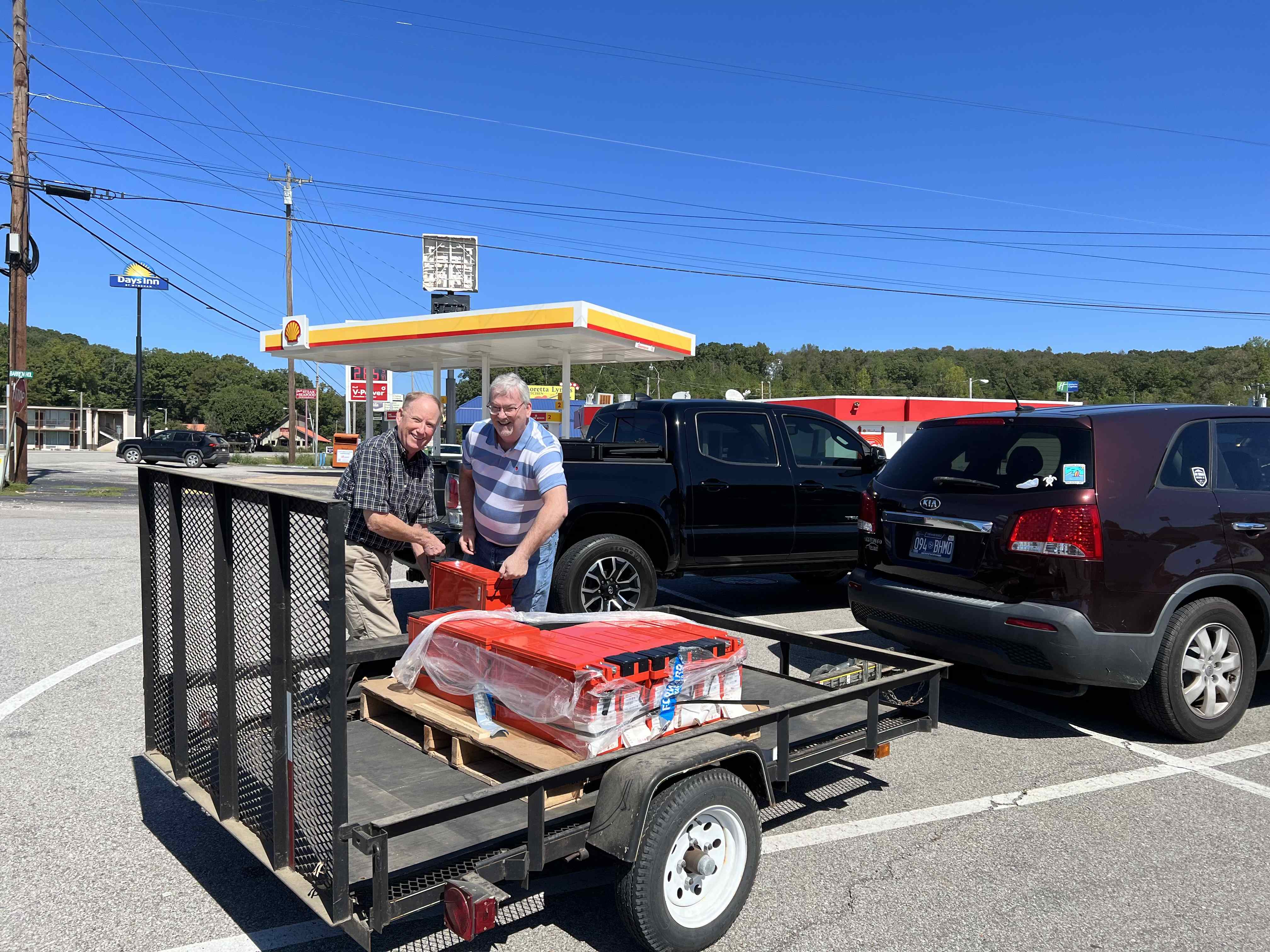
Batteries being delivered for the repeater. | | | |
|
In Tennessee, hams have rallied to return repeaters impacted by the storm to service.
Section Manager of the ARRL Tennessee Section David Thomas, KM4NYI, reports that a request for help on the TN ARES net resulted in batteries being donated and delivered to return the W4KEV repeater system to service, including the 145.410 machine located on Viking Mountain in Greene County, Tennessee, which covers much of the area in North Carolina and Tennessee that was decimated.
As connectivity via phone and data networks continues to return, ARRL expects more stories of amateur radio serving communities will emerge. Stories and local media coverage can be shared with ARRL via newsmedia@arrl.org.
While commercial communications networks and utilities are increasingly more resilient, Hurricane Helene has demonstrated that amateur radio is a critical partner that works When All Else Fails®.
|
|
Simulated Emergency Test (SET) Scheduled for October 5—6 |
|
The first weekend of October is when ARRL encourages local groups to hold the Simulated Emergency Test, or SET.
Throughout September, ARRL shared materials about resilience through National Preparedness Month.
Now, as entire areas are washed away in the aftermath of Hurricane Helene, the utility value of amateur radio is more necessary and visible than ever.
When disaster strikes, infrastructure fails.
As cellular data networks have gotten more robust, the need for a ready amateur radio service may seem to have diminished – and then we have situations like are happening in North Carolina.
Ham radio was the only functional tool for communication until cellular on wheels trucks and satellite internet terminals were deployed after several days of near total grid-down.
Radio amateurs have stepped up to serve – but they didn’t rise to the occasion; they relied on their training.
Rest assured, the success of these hams in passing critical information as well as health and welfare traffic didn’t just happen. They were trained, experienced, and ready.
One way hams can join the ranks of these prepared communicators is through the ARRL Simulated Emergency Test. The SET is ARRL’s primary national emergency exercise and is designed to assess the skills and preparedness of Amateur Radio Emergency Service® (ARES®)
volunteers, as well as those affiliated with other organizations involved in emergency and disaster response.
The SET encourages maximum participation by all radio amateurs, partner organizations, and national, state, and local officials who typically engage in emergency or disaster response.
In addition to ARES volunteers, those active in the National Traffic System® (NTS), Radio Amateur Civil Emergency Service (RACES), National Weather Service (NWS) SKYWARN®, Community Emergency Response Team (CERT), and a variety of other allied groups and public service-oriented radio amateurs are needed to fulfill important roles in this nationwide exercise.
“You can’t wait until amateur radio is necessary to start preparing.
Being ready starts well in advance.
The SET is a good opportunity to test equipment, modes, and skills under simulated emergency conditions and scenarios,” said ARRL Director of Emergency Management Josh Johnston, KE5MHV.
Radio amateurs can use the time to update a “go-kit” for use during deployments and to ensure their home station’s operational capability in an emergency or disaster.
To get involved, contact your local ARRL Emergency Coordinator or Net Manager.
|

|
|
|
An Incredible Amateur Radio Rescue Story |
|
Editor’s note: The following story was submitted by Don Gardner, W7PJ, ARRL Idaho Section Emergency Coordinator.
On the evening of September 21, 2024, Greg Owen, WX7Z, heard an amateur radio emergency call on the VHF frequency known as the national simplex calling frequency, 146.52 MHz. Ed Clark, K7ELC, was calling to get medical help for a 51-year-old man who had rolled his four-wheeler.
Mac Mackintosh, W7ENZ, found the accident and injured man near his property where there isn’t any cellphone service. Mackintosh had given his handheld radio to Clark to make the call for help while he gave aid to the injured man. The injuries were serious... head trauma, broken collarbone, broken ribs, and difficulty breathing.
Owen called 911 to request help. An ambulance, Life Flight helicopter and law enforcement were dispatched to the location, which was 35 minutes outside Orofino, Idaho. Meanwhile, Owen continued using the amateur radio to relay updates to the dispatcher. The injured man was transported to the hospital via Life Flight and at last report was recovering.
Gardner said hams in Idaho support an old national program called the Wilderness Protocol which encourages the use of the national simplex calling frequency, 146.52 MHz.
“As amateur radio operators, we train to be available to help when help is needed. The more that ham radio operators listen to the radio, the more chance there is that someone will be listening to take your emergency call. This is something that has been used many times throughout this county and here in Idaho,” he said. “This is another incredible story to share.”
|
|
The ARRL Foundation is Now Accepting Grant Applications Through October 31, 2024 |
|
There is funding available to organizations for eligible amateur radio-related projects and initiatives, particularly those with a focus on educating, licensing, and supporting amateur radio activities. Youth-based projects and initiatives are especially encouraged. The ARRL Foundation grants program accepts proposals on a cyclical basis three times a year, in February, June, and October. Awardees are notified approximately 1 month after the closing of each cycle.
|
|
|
David Bern, W2LNX, shows Pierce Pollard and Weston Pollard how to operate an amateur HF radio and how to make contacts. [Photo courtesy of David Bern, W2LNX] | | |
Recently, the ARRL Foundation provided funding for instructional materials to the Montgomery Amateur Radio Club (MARC), in Montgomery County, Maryland. MARC, led by David Bern, W2LNX, and John O’Brien, K3LO, held a Radio Merit Badge program on Saturday, June 22, 2024, at the MARC/Damascus Emergency Communications Team (DECT) Field Day site. This program provided Scouts an opportunity to earn the Radio Merit Badge by completing requirements which included conducting a QSO.
There were three amateur HF stations and one VHF-FM station on site, and another HF station in the MARC emergency communications trailer. Members explained how the stations worked and mentored the Scouts as they made QSOs. A total of 58 Scouts completed all requirements for the Radio Merit Badge.
The ARRL Foundation carefully manages a portfolio of endowments in which donors have provided specific goals for their gifts, and that portfolio is invested and managed so that it can continue to support those goals for many years to come.
Additional information and a link to the grant application form can be found at http://www.arrl.org/amateur-radio-grants.
|

|
|
|
Amateur Radio in the News |
|
“Ham radio demonstration to be held Saturday” / The Valley Breeze (Rhode Island) September 26, 2024 -- The Blackstone Valley Amateur Radio Club is an ARRL Affiliated Club.
“How to stay in touch when the grid goes down: ham radio, Wi-Fi, and other lifelines during disasters” / The Citizen (Georgia) September 29, 2024.
“Amateur radio operator helps in September 21 rescue” / Idaho County Free Press (Idaho) September 20, 2024 -- Clearwater County Emergency Management.
“When cell towers and internet fail, ham radio operators can still talk. How to get involved” / The News & Observer (North Carolina) October 3, 2024 -- The Raleigh Amateur Radio Society.
|
|
On the Air
Sponsored by Icom
A Tour of 10 Meters
The 10-meter band offers something for hams of every license class, including Technicians, who can use voice, Morse code, and digital modes on this band. Scott Freeberg, WA9WFA, joins this episode of the podcast to take us on “A Tour of 10 Meters,” and to explain why right now is the best time to get on the band, thanks to the terrific radio wave propagation being generated by Solar Cycle 25.
|
|
ARRL Audio News
Listen to ARRL Audio News, available every Friday.
ARRL Audio News is a summary of the week's top news stories in the world of amateur radio and ARRL, along with interviews and other features.
The On the Air podcast and ARRL Audio News are available on blubrry, iTunes, and Apple Podcasts.
On the Air
| ARRL Audio News
|
|
Each week, ARRL’s Maty Weinberg, KB1EIB, helps produce a version of the ARRL Letter to support members who are blind or have visual impairments. The ARRL Letter is available in an accessible format, posted weekly to the Blind-hams Groups.io
email group. The group is dedicated to discussions about amateur radio as it concerns blind hams, plus related topics including ham radio use of adaptive technology.
|
|
Jamboree-on-the-Air (JOTA) and Jamboree-on-the Internet (JOTI), the largest Scouting event in the world, takes place on the weekend of October 18 - 20, 2024. Youth amateur radio station WB4SA will be active for the event in a big way.
Ken Lyons, KN4MDJ, ARRL Southeastern Division Assistant Director for Radio Scouting and Trustee for WB4SA, said the club will host one of the largest sites in the country, with up to 2000 youth, during JOTA/JOTI weekend. Lyons said the club with active on:
|
-
80 meters SSB 3.690 & 3.940 MHz CW 3,570 MHz
-
40 meters SSB 7.090 & 7.190 MHz CW 7,030 MHz
-
20 meters SSB 14.290 MHz CW 14.060 MHz
-
17 meters SSB 18.140 MHz CW 18.080 MHz
-
15 meters SSB 21.360 MHz CW 21.140 MHz
-
12 meters SSB 24.960 MHz CW 24.910 MHz
-
10 meters SSB 28.390 MHz CW 28.180 MHz
-
6 meters SSB 50.160 MHz CW 50.160 MHz
And VHF simplex on 147.420, 146.580, and 146.520 MHz.
The Boy Scout and Girl Scout programs covered by the Central Division of Florida Division 2 includes 30,000 scouts in nine counties. For additional information, contact: Ken Lyons, KN4MDJ, Trustee for WB4SA, Cell 407-496-6694, BSA - Central Florida Council - www.RadioScouting.US/cfc.
|
|
The Ascension Amateur Radio Club
and the Thibodaux Amateur Radio Club
in Louisiana will combine to showcase science, technology, engineering, and mathematics (STEM) in amateur radio to over 1,000 Girl Scouts at the BIG (Believe in Girls) Expo at Nicholls State University in Thibodaux, LA. The event and amateur radio station W5YL will be active October 12, from 1400Z - 1930Z on 14.290, 14.230 SSTV, and 18.125 MHz, plus Digital Mobile Radio (DMR) talk group 907. Girls, grades K-12, and adults are invited to attend.
|
|
On October 5, 2024, from 10:00 AM - 5:00 PM MDT, members of the Deep Space Exploration Society
(DSES) in Kiowa County, Colorado, will be on hand to show off a new addition to the Plishner Radio Telescope. Activities will include demonstrating the 60-foot radiotelescope on the site. Science, technology, electronics, mathematics (STEM) activities and amateur radio lessons will be provided. An optical telescope will be on site and available for viewing the skies into the evening. In addition, a ham radio station using the DSES club call sign, KØPRT, will be on HF and VHF radio bands and will demonstrate EME (Earth-Moon-Earth) or moonbounce communication. For information about visiting the facility, contact Sobon at sobonpaul@gmail.com.
|
|
Craig Thompson, K9CT, is the featured presenter at the monthly Zoom meetup for the ARRL Collegiate Amateur Radio Program
(CARP) on Tuesday, October 8, 2024, at 8 PM ET / 5 PM PT. Thompson, who chairs the ARRL Contest Advisory Committee, will speak with students about the fun of amateur radio contesting and special opportunities for college and university radio clubs to compete. “The lessons learned will be remembered for the rest of your life and will help you in other ways,” said Thompson, an alumnus of Bradley University in Peoria, Illinois, where he was active with the school’s amateur radio club, W9JWC. He most recently traveled to St. Paul Island as part of the CY9C DXpedition team. College students and advisors will find a registration link for Tuesday’s Zoom meeting on the ARRL CARP web page at https://www.arrl.org/WeWantU.
|
|
The Collegiate QSO Party, an event focused on amateur radio clubs at colleges and universities around the world, will be on the air October 5, 2024, 0000 UTC to October 6, 2359 UTC. The event is open to all radio amateurs and provides an opportunity for clubs to demonstrate amateur radio to new members, engage with alumni, and promote activity throughout college and university communities. The event is also an opportunity to support new radio amateurs as they get on the air for the first time. Many collegiate students have been recently licensed or are just starting to develop their interest in the hobby. This event will give them a chance to make contacts with more than two dozen collegiate clubs that have registered to participate, which helps support the growth of amateur radio. More information is available at the Collegiate QSO Party website.
|
|
The Air Force Military Auxiliary Radio System
(AFMARS) celebrates its service to United States Military and Civilian government organizations November 5 - 11, 2024.
This will be “Air Force MARS 76 Years” special event and will include communications on amateur HF bands (80 - 6 meters) in the General license portion of the band and in the Technician license portion of 10 meters using SSB, CW and digital modes.
Amateurs who would like to participate will need to listen on a special group of frequencies, which will vary by geographic region, and respond to the “Air Force MARS Special Event CQ” calls. There is a list of frequencies which can be found at Air Force MARS 76th Special Event - APAN Community.
Stations that have made a confirmed contact with one or more Communication Wings will be eligible to receive an electronic certificate. Stations contacting 5 wings will be awarded a “Bronze” endorsement. Contact with 10 wings will be denoted “Silver”. Stations contacting all 10 Wings, and the Pentagon, Schriever SFB, Hancock Airfield and Travis AFB stations will receive “Gold” endorsements on their QSL Certificates. Certificates may be downloaded from Certificate Search (elemcoshopfloor.com)
after November 30, 2024.
The mission of AFMARS is provides contingency communications support on behalf of the men and women of the Department of Defense and other U.S Government users in support of their important and diverse whenever, however and whenever required.
|
|
Ham Radio Outlet
held its annual HRO Superfest at its large store in Milwaukee, Wisconsin, on September 20-21, 2024. The event doubled as an ARRL hamfest and hosted manufacturers, local radio clubs, and candidates for license examinations. A handful of forums were given, including one from Wisconsin Emergency Management, with an update on its role in activating trained radio amateurs to provide backup radio communications when primary communications fail. A busy ARRL table was organized by Assistant Manager of the ARRL Wisconsin Section Tom Czaja, KG9EE. Czaja reported that several of the couple dozen membership applications they signed were from young hams taking advantage of the new free ARRL membership for students
aged 21 and younger -- including one who passed his examinations at Superfest.
|

|
|
|
The all-volunteer team supporting ARRL at 2024 HRO Superfest included (left to right) former ARRL Wisconsin Section Manager Patrick Moretti, KA1RB; current Wisconsin Section Manager Jason Spetz, KC9FXE; Section Youth Coordinator Etienne Robitaille, K9ZN, and Assistant Section Manager Tom Czaja, KG9EE. Also attending was Central Division Director Carl Luetzelschwab, K9LA, and Vice Director Brent Walls, N9BA. | | | |
|
|
This image was taken on October 3, 2024 [Photo courtesy of NASA SDO/HMI] | | |
For this Friday’s ARRL Propagation Bulletin, ARLP040:
New sunspot groups emerged on every day over the past week. Two new regions appeared on September 26, another on September 27, two more on September 28, another on September 29, another on September 30, three more on October 1 and another on October 2, for a total of eleven.
The average daily sunspot number rose from 137.1 to 164.7, and average daily solar flux from 164.3 to 213.1. The average daily planetary A index shifted from 14.3 to 9.6.
Predicted solar flux is 250 on October 3 – 4; 235 on October 5; 230 on October 6 – 7; 220 on October 8 – 9; 185 on October 10; 175 on October 11 - 16; 170 on October 17 – 21; then 175, 180, 185, 190 and 195 on October 22 - 26, and 200 on October 27 – 29.
Predicted planetary A index is 15, 74, 52 and 15 on October 3 – 6; 5 on October 7 – 9; then 10, 20 and 19 on October 10 – 12; 5 on October 13 – 21; 28 and 10 on October 22 – 23; 5 on October 24 – 26, and 10 on October 27.
Sunspot numbers for September 26 through October 2, 2024, were 189, 122, 148, 154, 150, 196, and 194, with a mean of 137.1. The 10.7 -centimeter flux was 181.1, 186, 194.5, 197.2, 214.2, 244.6, and 274.4, with a mean of 164.3. Estimated planetary A indices were 13, 7, 7, 16, 11, 6, and 7, with a mean of 14.3. Middle latitude A Index was 11, 5, 5, 17, 5, 9, and 6, with a mean of 10.7.
|
-
October 5 - 6 -- WARC Collegiate QSO Party (CW, phone, digital)
-
October 5 - 6 -- Oceania DX Contest (phone)
-
October 5 -- 902 MHz and Up Fall Sprint (CW, phone, digital)
-
October 5 - 6 -- Russian WW Digital Contest (digital)
-
October 5 - 6 -- IARU Region 1 UHF/Microwaves Contest (CW, phone, digital)
-
October 5 - 6 -- International HELL Contest (digital)
-
October 5 - 6 -- California QSO Party (CW, phone)
-
October 6 -- UBA ON Contest, SSB (phone)
-
October 6 -- Peanut Power QRP Sprint (CW, phone)
-
October 7 -- RSGB 80m Autumn Series (CW)
-
October 8 -- ARS Spartan Sprint (CW)
-
October 8 -- DARC RTTY Sprint (digital)
-
October 8 -- IRTS 80m Evening Counties Contest (CW, phone)
Visit the ARRL Contest Calendar for more events and information.
|
|
Upcoming Section, State, and Division Conventions |
-
October 5 | Wichita Area Hamfest, sponsoring the ARRL Kansas State Convention, Wichita, Kansas
-
October 5 | Northstar Radio Convention, sponsoring the ARRL Minnesota State Convention, Brooklyn Park, Minnesota
-
October 12 | Rock Hill Hamfest, sponsoring the ARRL South Carolina Section Convention, Rock Hill, South Carolina.
-
October 13 | Nutmeg Hamfest, sponsoring the ARRL Connecticut State Convention, Meriden, Connecticut
-
October 18 - 20 | Pacificon, sponsoring the ARRL Pacific Division Convention, San Ramon, California
-
November 2 | Wisconsin ARES/RACES Conference 2024, sponsoring the ARRL Wisconsin State Convention, Wisconsin Rapids, Wisconsin
-
November 2 -3 |Stone Mountain Hamfest, sponsoring the ARRL Georgia State Convention, Lawrenceville, Georgia
Search the ARRL Hamfest and Convention Database
to find events in your area.
|
|
Have News for ARRL?
Submissions for the ARRL Letter and ARRL News can be sent to news@arrl.org. -- John E. Ross, KD8IDJ, ARRL News Editor
|
|
ARRL -- Your One-Stop Resource for Amateur Radio News and Information
Join ARRL or renew today!
No other organization works harder to promote and protect amateur radio. Membership supports benefits, services, programs, and advocacy to help you get (and stay) active and on the air. Membership includes access to digital editions of all four ARRL magazines: QST, On the Air, QEX, and NCJ.
Listen to ARRL Audio News, available every Friday.
The ARRL Letter is available in an accessible format, posted weekly to the Blind-hams Groups.io
email group. The group is dedicated to discussions about amateur radio as it concerns blind hams, plus related topics including ham radio use of adaptive technology.
NCJ -- National Contest Journal. Published bimonthly, features articles by top contesters, letters, hints, statistics, scores, NA Sprint, and QSO parties.
QEX -- A Forum for Communications Experimenters. Published bimonthly, features technical articles, construction projects, columns, and other items of interest to radio amateurs and communications professionals.
Free of charge to ARRL members...
Subscribe
to the ARES Letter (monthly public service and emergency communications news), the ARRL Contest Update (biweekly contest newsletter), Division and Section news alerts, and much more!
Find ARRL on Facebook! Follow us on Threads, X, and Instagram.
| |
|
The ARRL Letter is published Thursdays, 51 times each year. ARRL members may subscribe at no cost or unsubscribe by editing their profile at www.arrl.org/opt-in-out.
Copyright © 2024 American Radio Relay League, Incorporated. Use and distribution of this publication, or any portion thereof, is permitted for non-commercial or educational purposes, with attribution. All other purposes require written permission.
|
|
| |
| | | |